


What is a Dissertation?
Understanding the Meaning of a Dissertation
Definition and Purpose
If you’re studying in the UK, you’ve probably heard the word “dissertation” thrown around like it’s some kind of academic monster. But let’s simplify it. A dissertation is essentially a long piece of academic writing based on original research, usually required at the end of an undergraduate or postgraduate degree. (Scribbr)
Think of it like this: if your degree is a journey, your dissertation is the final boss battle. It’s where you prove that you can think independently, analyse information critically, and contribute something new, no matter how small to your field.
In UK universities, a dissertation is not just about repeating what others have said. It’s about identifying a gap in knowledge, asking a meaningful question, and answering it through structured research. This could involve surveys, interviews, experiments, or even deep analysis of existing literature. The goal is to show that you can handle academic work at a professional level.
Another important thing to understand is that dissertations vary depending on your subject. For example, a business or social sciences dissertation often includes data collection and analysis, while a humanities dissertation might focus more on argument-building and critical interpretation. Regardless of the field, the core purpose remains the same: demonstrate your ability to conduct independent research and present it clearly.
Why UK Universities Require Dissertations
So why do UK universities put students through this intense process? Simple! Because it tests everything at once. A dissertation is designed to assess multiple academic skills in a single project, including research, writing, time management, and critical thinking.
According to academic guidelines, dissertations show whether a student can plan and execute research, justify their methods, and communicate findings effectively. (Lou Coll Library) That’s a big deal, especially when employers are looking for graduates who can think independently and solve problems.
There’s also a practical reason. A dissertation prepares you for real-world challenges. Whether you’re entering a corporate job, pursuing a master’s degree, or going into research, the skills you develop here are directly transferable. You learn how to handle large projects, meet deadlines, and deal with uncertainty, all of which are crucial in professional life.
In short, UK universities use dissertations to separate surface-level learners from those who truly understand their subject. It’s not just an assignment; it’s proof of your academic maturity.
What is in a Dissertation? Full Structure Explained
Core Sections Overview
Understanding what is in a dissertation is half the battle. Once you know the structure, the whole process becomes much less intimidating. Most UK dissertations follow a standard format, even though slight variations exist depending on the subject.
Here’s a quick breakdown:
| Section | Purpose |
| Abstract | Summary of the entire research |
| Introduction | Sets the context and research question |
| Literature Review | Reviews existing studies |
| Methodology | Explains research methods |
| Results | Presents findings |
| Discussion | Interprets results |
| Conclusion | Summarises contributions |
This structure ensures that your work flows logically from start to finish. It’s like telling a story, starting with a question and ending with an answer.
Abstract
The abstract is a short summary of your dissertation, usually around 150–300 words, covering your research aim, methods, findings, and conclusions. (UKEssays.com)
Even though it’s placed at the beginning, it’s written last. Why? Because you can’t summarise something you haven’t finished yet. Think of it as the trailer of your dissertation, it gives readers a snapshot of what to expect.
Introduction
This section introduces your topic, explains why it matters, and clearly states your research question. It also outlines the structure of your dissertation, so readers know what’s coming next. A strong introduction sets the tone for the entire project.
Literature Review
The literature review is where you explore existing research related to your topic. It’s not just a summary, it’s a critical analysis of what others have done and what’s still missing.
Methodology
This chapter explains how you conducted your research. Did you use surveys? Interviews? Statistical analysis? This section must justify your choices and show that your approach is reliable.
Results and Discussion
Here, you present your findings and interpret what they mean. The results show what you found, while the discussion explains why it matters.
Conclusion
The conclusion wraps everything up. It answers your research question and highlights the contribution your work makes.
What is an Abstract in a Dissertation?
Purpose of the Abstract
Let’s zoom in on one of the most important parts: the abstract. Many students underestimate it, but it’s one of the first things examiners read.
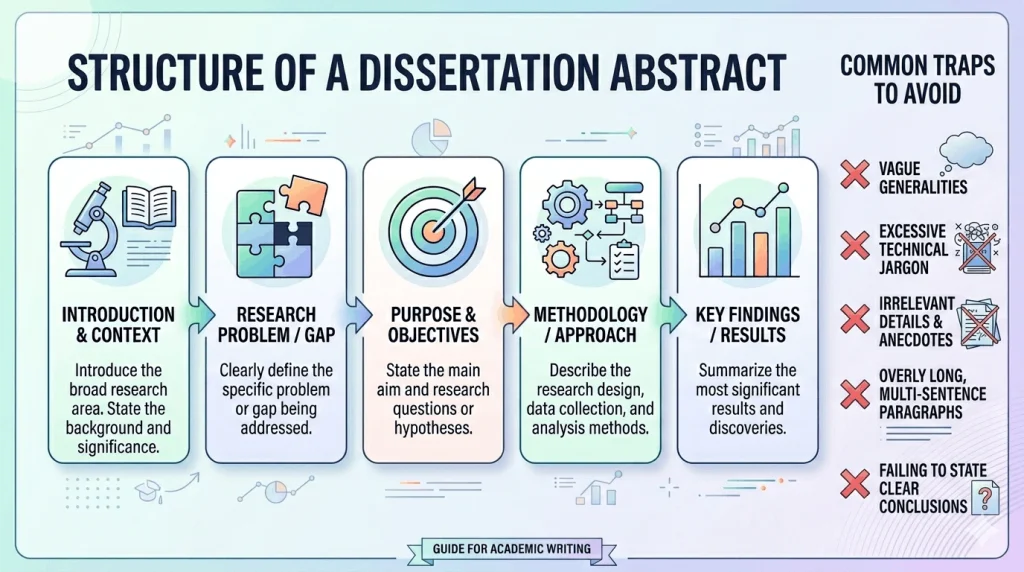
The abstract is a concise summary of your entire dissertation, explaining what you studied, how you did it, and what you found. (Academic Universe) Think of it as your academic elevator pitch, if someone only reads this section, they should still understand your research.
In UK universities, a well-written abstract can set the tone for the whole dissertation. If it’s clear and focused, it signals strong research. If it’s vague, it raises doubts before the reader even gets to the main content.
Key Elements to Include
A strong abstract usually includes:
- Research topic and objectives
- Methodology used
- Key findings
- Final conclusions
Each sentence should serve a purpose. No fluff, no unnecessary details, just clear, impactful information.
What is a Literature Review in a Dissertation?
Definition and Role
Now let’s tackle another big question: what is a literature review dissertation section?
A literature review is where you analyst existing research related to your topic. But here’s the catch, it’s not just about summarizing studies. It’s about identifying patterns, contradictions, and gaps. (Scribbr)
Imagine you’re joining a conversation that’s been going on for years. The literature review is your way of showing that you understand what’s already been said before adding your own voice.
How to Structure a Literature Review
There are several ways to structure it:
- Chronological (by time)
- Thematic (by topic)
- Methodological (by research method)
The key is to build a logical argument that leads directly to your research question. By the end of this section, it should be obvious why your study is necessary. Check full blog for more information: How to Write a Literature Review for a Dissertation?
What is a Methodology in a Dissertation?
Types of Research Methods
The methodology section explains how you conducted your research. This is where you prove that your study is credible and reliable.
Common research types include:
- Qualitative (interviews, observations)
- Quantitative (surveys, statistical data)
- Mixed methods (combination of both)
Each method has its strengths and weaknesses, and your job is to justify why you chose a particular approach.
How to Write a Methodology Section
A strong methodology should include:
- Research design
- Data collection methods
- Analysis techniques
- Limitations
This section is all about transparency. You’re basically saying, “Here’s exactly how I did my research, judge it for yourself.” check full blog for more details : How to Write a Methodology Chapter for a Dissertation?
Step-by-Step Dissertation Writing Process
Planning and Research
Writing a dissertation doesn’t happen overnight. It starts with choosing a topic, developing a research question, and conducting a literature review. This stage is all about preparation.
Writing and Editing
Once your research is done, you move on to writing. This involves drafting each chapter, revising your work, and ensuring everything flows logically. Editing is just as important as writing, it’s where good dissertations become great ones.
Common Mistakes Students Make
Many students struggle with dissertations, and the mistakes are often predictable. Some rely too heavily on description instead of analysis. Others choose topics that are too broad or too vague.
Another common issue is poor time management. A dissertation is a long-term project, and leaving everything until the last minute rarely ends well.
Tips to Write a High-Scoring UK Dissertation
If you want top marks, focus on:
- Clear research questions
- Strong critical analysis
- Logical structure
- Consistent referencing
Think of your dissertation as a puzzle. Every section should fit together perfectly to form a complete picture.
Conclusion
A dissertation might seem overwhelming at first, but once you understand its structure and purpose, it becomes much more manageable. It’s not just an academic requirement; it’s an opportunity to explore a topic you care about and develop skills that will stay with you long after graduation. By mastering key sections like the abstract, literature review, and methodology, you can turn a daunting task into a rewarding achievement.
FAQs (Frequently Asked Questions)
1. What is a dissertation in simple terms?
2. How long is a UK dissertation?
3. What is a literature review in a dissertation?
4. What is an abstract in a dissertation?
5. What is a methodology in a dissertation?
Ready to Elevate Your Grades?
Our Native UK Experts are standing by to help you with 100% original, high-quality work tailored to your exact requirements.