

The Role of Literature Review in Academic Research | Dissertation Guide
In a Nutshell: A literature review is commonly conceived of as a mere overview of books and journals that you have read. But in the British academia, it is the most important aspect of your research. It serves as a guide to your whole project as it shows that your work is based on the already known knowledge and also determines the gap that your work will aim to fill.
If you are learning how to write a dissertation UK, you have to approach the literature review as a critical conversation with scholars, not a list. In this guide, we will also deconstruct the importance of this section and how you can best organize it to be the most impactful.
Why the Literature Review is the Backbone of Your Research
The main task of a literature review is to exhibit your academic literacy. It demonstrates to your examiners that you possess an in-depth understanding of the theories, debates, and methodologies pertaining to your topic.
Beyond just showing off your reading list, a strong review:
- Contextualises your study: It puts your research into context with the broader scholarly field.
- Avoids duplication: It makes sure that you do not re-invent the wheel and repeat a study that has been already done perfectly.
- Points out contradictions: It bri ngs into the limelight, where various scholars disagree, and you have an opportunity to weigh in.
In case you are having difficulties synthesising intricate theories, professional dissertation writing assistance may help to structure your ideas into a logical scholarly argument.
How to Write a Literature Review for a Dissertation (UK Style)
The shift that needs to be made when writing a review on a university in the UK is that of “What happened? to Why does it matter? This is three step, which is Search, Evaluate, and Synthesise.
1. The Search Phase
Do not use the first page of Google Scholar. Search academic databases such as EBSCO, JSTOR or the EthOS database at the British Library to locate quality, peer-reviewed theses and journals.
2. The Evaluation Phase
Ask yourself: Is this source up-to-date? Does it have a defective methodology? Is the author biased in some way? In the UK university dissertation guide, “criticality” is the word that scores the most marks.
3. The Synthesis Phase
Instead of showing the authors separately, unite their views to create a more robust argument. To illustrate, rather than provide a summary of Smith (2022) and Jones (2023) in isolation, compare them: whereas Smith (2022) endorses the role of the quantitative approach to urban planning, Jones (2023) argues that it frequently ignores some important qualitative social aspects.
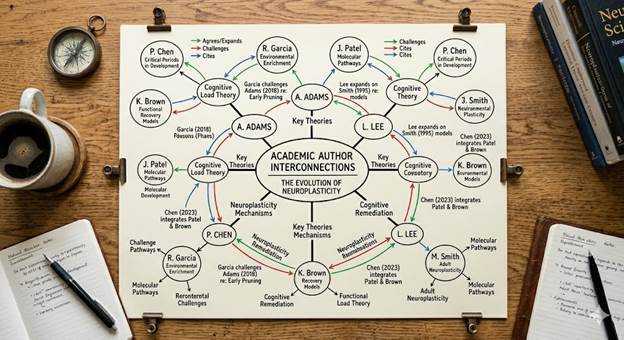
Common Literature Review Structure UK Universities Recommend
Although there is no best method of organising your review, these three structures are most favoured by most successful UK students:
Thematic Structure
This is the most favored method. You organise your review around different themes or topics. As an illustration, when you are writing on the subject of Remote Work, your themes could be:
- Employee Productivity
- Mental Health Impact
- Technological Infrastructure
Chronological Structure
You trace the development of a topic over time. This is great when dealing with historical subjects or subjects where technology has quickly transformed the subject.
Methodological Structure
When your dissertation topic is about the process of research, it may be helpful to locate sources according to the type they performed their research- either qualitative or quantitative.
Expert Dissertation Writing Tips for a Perfect Review
- Keep it Current: Have at least 70% of your sources be within the past 5-10 years, except when it comes to seminal (classical) theories.
- Signpost Your Writing: Mark the transition words such as furthermore, contrary and in line with by transition words to help the reader follow your line of reasoning.
- Stay Relevant: When a book is interesting but does not directly answer your particular research question, then skip it. Word count is precious!
Need help narrowing down your sources? Our experts at Online Dissertation Advisors can help you select the most impactful literature for your specific field.

Moving from Review to Research Gap
The ultimate goal of learning how to write a dissertation UK style is to find the “gap.” This is where you indicate in your literature review that you know A, B and C, but you do not know D yet, and that is what my dissertation will explore.
It is a lack of this gap that makes your dissertation lack a Raison d’être. To get further assistance on how to phrase your academic research and find your research niche, visit the University of Reading’s Study Advice pages.
Ready to get started? Don’t get the pressure on your shoulders when you are still struggling with your dissertation structure UK. Get a Free consultation on how to write your academic paper today! Visit Online Dissertation Advisors.
Frequently Asked Questions (FAQs)
1. What is the length of a literature review in UK dissertation?
Typically, the literature review makes up about 25% to 30% of your total word count. In a 10,000-word dissertation your review ought to be between 2,500 and 3,000 words.
2. Am I allowed to utilize websites in my literature review?
In most cases, you would want to adhere to peer-reviewed journals, books, and official government reports. Only use websites provided they are of high-authority organisations (such as the NHS or World Bank) and not blogs or Wikipedia.
3. What in case there is excessive literature on my topic?
You should reduce your inclusion criteria in case you are overwhelmed. To manage the review, limit your search to a geographical region, time period or demographic.
4. Can I provide my own opinion in literature review?
Your critical analysis of others should be a way of expressing your opinion. Rather than telling that I believe that Smith is wrong, tell that probably the results of the findings might be biased by a small sample size, and that more research should be conducted.
Ready to Elevate Your Grades?
Our Native UK Experts are standing by to help you with 100% original, high-quality work tailored to your exact requirements.