

How to Write a Methodology Chapter for a Dissertation?
The chapter methodology is the strength of your dissertation. It is where you explain your method of research and prove to your supervisor that your results are credible, reliable, and valid. In fact, this part of the research can be quite overwhelming to many students; however, once you select the appropriate methodology for your particular research question, writing becomes much easier.
In this guide, we are going to dissect the key elements of a methodology chapter, which will make you navigate through the academic requirements of the UK universities. No matter what type of research you are doing, qualitative, quantitative, or mixed methods, having an effective roadmap is the key to academic success. When you get yourself in a fix, you can always get professional assistance at Online Dissertation Advisors.
Understanding the Purpose of the Methodology Chapter
Your methodology chapter at its core describes how you gathered and analyzed your data. It is not just a list of tasks that are to be done; it is a start and stop analysis of your research design.
There are two things your examiners are after:
- Transparency: Would you have another researcher be able to reproduce your study with the information you give?
- Justification: Have you used the best tools to respond to your particular research question?
Connecting Theory to Practice
Your methodology is a connection between your literature review and your results. You have to show that your judgments are based on scholarly literature and not arbitrary.
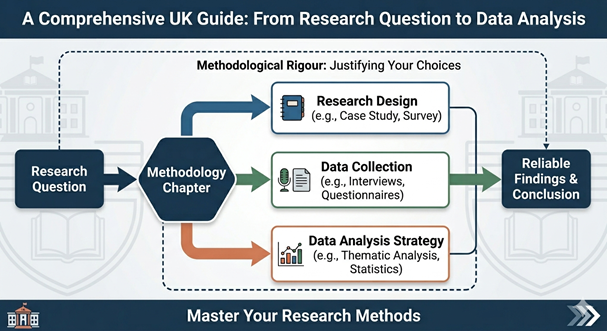
Essential Components of Your Methodology
To compose a high-scoring chapter, you have to organize your chapter in a logical manner. Although certain university demands differ, the majority of the UK institutions anticipate the following sections.
1. Research Philosophy and Approach
Begin by stating your ontological and epistemological position. Are you a positivist, interpretivist or pragmatist? The philosophical stance that you are in determines your perception of the world and, later on, your interpretation of your data.
In selecting a research approach (deductive, inductive, or abductive), make sure that it is consistent with your research objectives. As an illustration, quantitative research is often dedicated to deductive research, whereas inductive research is more suitable when it comes to qualitative exploration.
2. Research Design
This part will describe your general plan. Do you do a case study, an experiment, ethnography, or a survey? Be specific.
State the reasons why you chose this design. As an example, assume that you select a case study research design and justify how the study will enable a detailed exploration of a complex problem in its context. To further develop your design, consider The Open University’s guide on research methods.
3. Data Collection Methods
This is the “nuts and bolts” of your chapter. Detail your instruments:
- Surveys/Questionnaires: Discuss design, sampling, and distribution.
- Interviews: The interviews will be structured (structured, semi-structured, or unstructured) and participants selected based on criteria described. Also:
- Secondary Data: In case you are using some already existing datasets, state how and where they were obtained and how reliable they are. Always put into consideration your participants.
Make sure that you follow ethical guidelines, which you can learn more about through the Economic and Social Research Council (ESRC).
4. Data Analysis Strategy
What meaning will you make of the information you will have gathered?
- In case of quantitative data, specify your statistical program (e.g., SPSS, R) and tests you undertook.
- For qualitative data, discuss thematic analysis, discourse analysis, or grounded theory. Be clear on the manner in which you handled the data.
In case of difficulties with organization of your data analysis, visit Online Dissertation Advisors to obtain individual feedback.
How to Choose the Right Methods for Your Study
This is the most frequent error that students commit choosing a method due to its apparent ease, not because it is suitable. Always trace back your approach to your research question to make a good selection.

Practical Tips for Success
- Be Descriptive, Not Theoretical: Avoid simply defining what an interview is, tell how you did your interview.
- Consider Limitations: There is no perfect methodology. It is not only more credible as an academic when you are truthful about the drawbacks of your method, including sample size or possible bias.
- Be Consistent: Use your methodology in a logical progression of your research questions. When you are dealing with questions that are interested in why and how, then be sure to adopt qualitative approaches that will permit depth.
In case you are having a problem balancing this, you can seek professional advice with Online Dissertation Advisors to make sure your chapter meets the requirements of UK academia.
Reliability, Validity, and Ethics
These three pillars cannot be compromised in the academic setting of the UK.
- Reliability: Will your study produce the same results?
- Validity: Have you measured what you wanted to measure?
- Ethics: Have you received informed consent? Have you done anything to maintain participant anonymity and data protection (GDPR compliance)?
Describing your ethical considerations will demonstrate that you are a responsible researcher. Not dealing with them may lead to a lot of deduction of marks, no matter how well you analyze it.
Final Review: Checklist for Your Methodology Chapter
This checklist will help you make sure that you have some of the basics covered before you hand in your draft:
- Did I explain the reasons that I take my particular ways?
- Is my research question related to my data collection?
- Did I talk about the ethical considerations and restrictions?
- Does it have a professional and scholarly tone?
- Did I provide all the references that I needed in my citations to the methodology?
Need an eye to proofread your work? You may get the full assistance at Online Dissertation Advisors.
Frequently Asked Questions (FAQ)
1. How long should the methodology chapter be?
On average, the methodology chapter will take up 15-20 percent of your overall word count. Nevertheless, when in doubt, always refer to your handbook that is in your particular department since the requirements differ across institutions.
2. Can I change my methodology after I have started?
Yes, study is cyclical. In case your original plan does not give you the data required, then you can vary it; however, you need to explain what you have changed and why you should have done so in your chapter.
3. What is the difference between research methods and methodology?
Methods are the names of the particular tools (e.g., surveys, interviews). The larger theoretical framework that explains why you have selected these particular tools to answer your research question is termed methodology.
4. Do I need to include a pilot study?
Pilot study is very much encouraged particularly in primary research. It enables you to check your tools and find out possible problems, proving to your bosses the high level of academic rigour.
5. How do I write about limitations effectively?
Limitations on frames as a chance of critical reflection. Rather than stating that your research was weak, state the limitations that you had (e.g., time or access) and propose how this can be filled in by future research.
Ready to Elevate Your Grades?
Our Native UK Experts are standing by to help you with 100% original, high-quality work tailored to your exact requirements.