
What Is the Harvard Referencing System?
Definition and Core Concept
The Harvard referencing system is an author-date citation style used to acknowledge sources in academic writing. In simple terms, it involves citing the author’s surname and the year of publication within the text, and then providing full details of the source in a reference list at the end of the document (Scribbr).
For example, a basic Harvard citation looks like this:
(Smith, 2020)
If you’re quoting directly, you might include a page number:
(Smith, 2020, p. 45)
This method allows readers to quickly identify the source without interrupting the flow of the text. The full reference—containing details like the title, publisher, and publication dates are then listed alphabetically at the end of the document.
History and Origin of Harvard Style
Interestingly, the Harvard referencing system didn’t officially originate from Harvard University itself. It dates back to the late 19th century when scientists began using an author-date format to cite sources. Over time, this system evolved and became associated with Harvard due to its widespread use in academic publications (CiteWithMe).
Today, Harvard referencing is not a single standardized style. Instead, it’s a generic term for a family of author-date referencing systems. Different universities may have slightly different rules, but the core principle remains the same: cite the author and date in the text, and provide full details in a reference list (libguides.westminster.ac.uk).
Referencing in academic writing fulfills many roles. It
avoids cases of plagiarism, a major offense in academic writing. Secondly, it
enables your reader to go further and confirm your sources. Finally, it adds
more strength to the arguments that have been made. Any form of work that is
not properly cited lacks its credibility, according to academic rules and
regulations.
Why the Harvard Referencing System Matters
Why Referencing Matters
The phrase “cite your sources” might not be new to anyone who has written any form of academic papers before. However, it goes far beyond mentioning names and dates here and there on the paper. The process of referencing involves acknowledging the source of information used in any academic writing. This implies that if you have incorporated any information in your papers that is not your own, then it must be correctly cited and referenced. One of the popularly used forms of referencing is the Harvard referencing method.
Referencing in academic writing fulfills many roles. It avoids cases of plagiarism, a major offense in academic writing. Secondly, it enables your reader to go further and confirm your sources. Finally, it adds more strength to the arguments that have been made. Any form of work that is not properly cited lacks its credibility, according to academic rules and regulations.
Common Referencing Styles Compared
The different types of referencing styles include, but are not limited to, APA style, MLA style, Chicago Style, and Vancouver style, among others. For instance, the MLA referencing system is more inclined towards author-page style, whereas the APA referencing style puts emphasis on author-date citation style. What makes the Harvard referencing style unique is its simplicity and versatility. This referencing system is extensively applied in higher learning institutions in countries such as the United Kingdom and Europe. (CiteWithMe).
What makes Harvard referencing unique is its straightforward approach. Instead of complicated footnotes or numbering systems, it uses a clear author-date format, making it easy for readers to identify sources quickly. This simplicity is one of the main reasons why students and researchers prefer it over other styles.
Understanding In-Text Citations
Harvard referencing is the characteristic of “Author-Date” style. In quoting, paraphrasing, or summarizing an idea, you should always remember to add the name of the author and the year in which he or she wrote. This lets the reader know the source of information.

Basic In-Text Rules:
- Paraphrasing: In the case of paraphrasing, i.e., explaining something in your own words, you do not use quotation marks, but you must cite it: “Recent researches indicate that the level of student engagement directly correlates with the use of libraries (Smith, 2024).”
- Direct Quotes: When you are referring to the direct words of a source, you have to employ quotation marks and give the page number: “The shift to online learning has been rapid (Brown, 2023, p. 45).”
- Multiple Authors: Use “et al.” when there are three or more authors. It is a typical requirement of numerous UK universities: (Jones et al., 2022).
How to Compile Your Reference List
The last and vital part of your document is your reference list (or bibliography). It must provide a list of all the sources that you have used, in alphabetical order by the surname of the author. In contrast to your in-text citations, this list includes the complete, disaggregated information about the publication.
Structure for a Book:
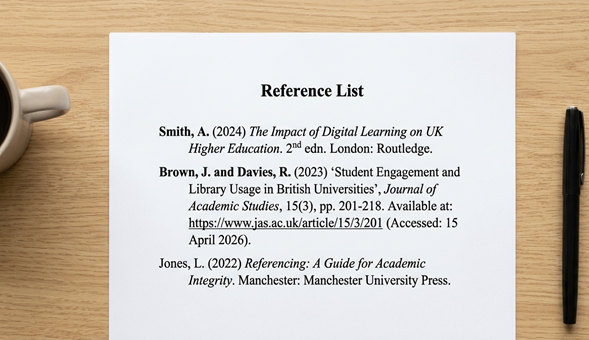
Surname, Initial. (Year of Publication) Title of book. Edition (unless the first). Place of publication: Publisher.
Example:
Smith, J. (2024). Future of Higher Education in the UK. 2nd edn. London: Academic Press.
Have questions about how to structure a huge bibliography to complete your final project? Online Dissertation Advisors can help you with formatting and proofreading your reference lists to comply with particular university requirements.
Handling Online Sources and Journals
In the new digital era, you will probably be referencing more than mere books. The Harvard Referencing System of digital sources needs some minor modification, typically, you have to add the URL address and the date you accessed the information so that the reader could understand when you accessed the information.
Citing a Journal Article:
Surname, Initial. (Year) ‘Title of article’, Title of Journal, Volume(Issue), pp. page numbers. Location: URL (Accessed: Day Month Year).
To learn more about how UK universities want you to work with complex digital sources and academic language, refer to the University of Manchester’s Academic Phrasebank, a great source of information about raising the standards of your academic writing.
Common Mistakes to Avoid
Even confident students might make little mistakes, which have an adverse effect on a final grade. The most pitfalls to avoid are as follows:
- Lack of Citations for Paraphrased Ideas: It is a common mistake among students to think that they should only reference direct quotes. Keep in mind: It is necessary to reference the idea or information provided it is not your own, whether it is a quote or a summary.
- Ineffective Formatting: If you italicize the titles of books, you should make sure that you do the same on all the book titles in your list. The hallmark of rushed, amateurish work.
- “Et al.” Confusion: You should always refer to your particular university handbook. There are departments that like you to put all the authors, and those that are adamant that you use et al. after three names.
To submit stress free, consider our dissertation writing service so that you do not have to worry about your referencing anywhere in your entire manuscript, but instead work on your arguments.
Digital Tools and Software
You do not need to enter each and every reference manually. A lot of students apply the reference management software to simplify the process. Zotero or Mendeley (or EndNote) can automatically create your bibliography using the Harvard Referencing System. But beware; do not put your trust in these instruments.
They usually commit capitalization, punctuation or regional university errors. Always make sure to examine the output in relation to the official style guide of your university. To get additional advice on academic integrity and ethical use of these tools, you may refer to the standards given by the Quality Assurance Agency (QAA).
Conclusion: Consistency is Key
Harvard referencing system may appear to be a strictly mechanical exercise, but it is in fact a crucial aspect of the academic dialogue. Citing your sources properly is not only a sign of respect to the past researchers, but also a good indication of a clear and true roadmap to your own educational path.
The key of success lies in consistency. Select one system, adhere to it and never forget to proofread your work before the deadline. Should you get lost in the technicalities then you can always count on Online Dissertation Advisors to give you the professional help you require in order to shine and be what you can be.
Ready to Elevate Your Grades?
Our Native UK Experts are standing by to help you with 100% original, high-quality work tailored to your exact requirements.