AI can save time during university work, but only when the tool matches the task. A chatbot that is useful for explaining a difficult theory may not be the best place to search for peer-reviewed studies, while a specialist research platform may be excellent for finding evidence but less useful when you need to improve the wording of a final paragraph. This is why choosing the right academic writing tools matters more than simply choosing the most popular AI platform.
In 2026, students have access to far more than general-purpose chatbots. AI for academic writing now includes research assistants, citation tools, literature-review platforms, academic editors and general-purpose online AI writing assistants. Some help locate scholarly evidence, some reveal citation relationships, and others focus on improving academic language and clarity.
For students writing essays, assignments, dissertations, theses or literature reviews, the real question is therefore not simply “What is the best AI for writing?” It is “Which AI tool is best for the part of academic work I am doing right now?” This guide compares 10 leading options and explains where each tool is useful, where its limitations begin and how different tools can work together responsibly.
This guide compares 10 useful AI tools for academic writing and research in 2026, including ChatGPT, Elicit, Consensus, Scite, ResearchRabbit, Paperpal, Writefull, Grammarly, QuillBot and Perplexity. It also explains where each tool is most useful, where its limitations begin and how several tools can fit together in a responsible academic workflow.
If you are working on a larger research project, you may also find our guide on how to write a dissertation in the UK useful alongside this comparison.
Which AI Tool Is Best for Academic Writing?
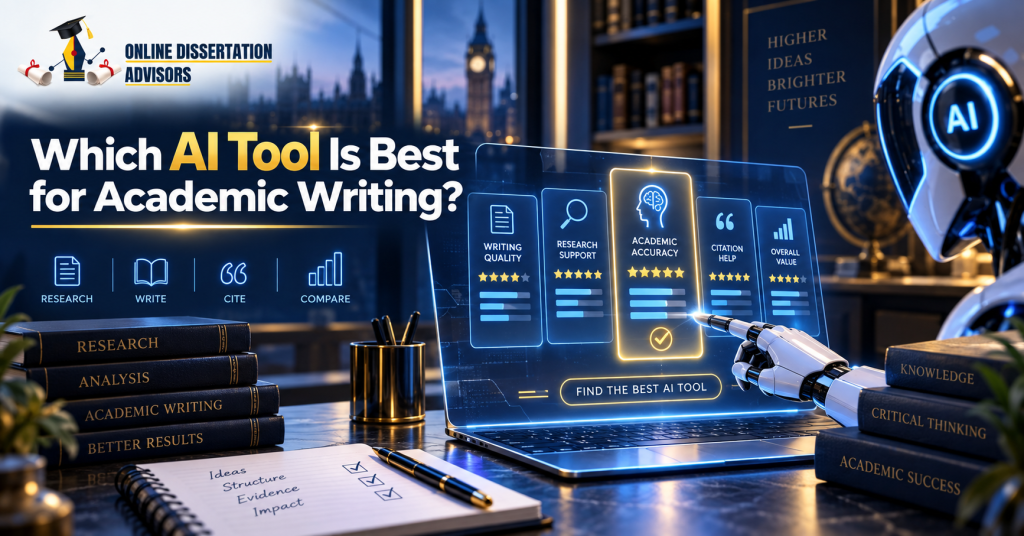
There is no single AI tool that is best at every stage of academic work. Someone searching for the best writing AI may actually need several different capabilities. ChatGPT is particularly flexible for planning, explanations, research questions and reviewing ideas. Elicit and Consensus are more specialised for finding academic evidence, Scite helps investigate how published studies have been treated by later research, and ResearchRabbit is useful for discovering related papers. Paperpal and Writefull focus more heavily on scholarly writing, while Grammarly and QuillBot support language-level revision.
The most effective approach is usually to use different tools for different academic jobs rather than expecting one platform to research, evaluate evidence, write, reference and edit an entire assignment accurately.
| Tool | Best For | Useful At | Main Limitation |
|---|---|---|---|
| ChatGPT | Planning and research support | Ideas, explanations, structure, review | Important claims and sources still require verification |
| Elicit | Literature reviews | Paper search, screening and evidence synthesis | More specialised than a general writing assistant |
| Consensus | Research-backed answers | Exploring what published research says | Does not replace critical reading of the papers |
| Scite | Checking academic evidence | Citation context and evidence evaluation | Not primarily a writing or editing tool |
| ResearchRabbit | Discovering related literature | Citation-network exploration | Should complement database searching |
| Paperpal | Academic writing and editing | Research, citations and language revision | Many features are geared towards research writing |
| Writefull | Thesis and research language | Academic language and sentence-level revision | Not intended as a literature-search platform |
| Grammarly | Grammar and clarity | Draft revision and writing transparency | Suggestions can occasionally alter intended meaning |
| QuillBot | Paraphrasing support | Rewording and fluency | Paraphrasing never removes citation obligations |
| Perplexity | Fast source-based research | Orientation and current web research | General web results should not replace academic databases |
How We Chose These AI Tools
This comparison considers the tools’ current documented capabilities, usefulness during common university tasks, transparency around sources, relevance to academic research or writing, and the limitations students need to understand before relying on them. The “best for” labels are editorial recommendations based on those differences; they are not rankings supplied by the companies themselves.
Features can change quickly, so students considering a paid plan should always check the provider’s current website before subscribing. More importantly, the quality of an AI platform does not determine whether its use is permitted in a particular assessment. Your university, department or module instructions still take priority. We have therefore not treated the tool that generates the most text as automatically being the best AI writer. For university work, research quality, source transparency, academic relevance and the ability to support rather than replace critical thinking matter just as much as writing speed.

1. ChatGPT – Best for Planning, Explaining and Research Support
ChatGPT is the most flexible tool in this comparison because it can be used at several different stages of academic work. A student can use it to turn a broad subject into possible research questions, explain an unfamiliar theory in simpler language, compare concepts, identify weaknesses in an argument, organise an outline or review the clarity of an existing draft.
Its research capabilities also go beyond ordinary conversation. OpenAI’s current research guidance describes ChatGPT as capable of helping users build research plans, gather and synthesise information, compare sources and produce structured outputs with citations when search or deep research is used. OpenAI’s academic guidance also emphasises that users remain responsible for accuracy, attribution and compliance with institutional rules.
That makes ChatGPT particularly useful as a thinking and research partner, rather than something that should simply produce an assessed essay from a prompt. For example, you might ask it to compare three possible dissertation questions, explain what evidence each would require and identify where the scope is still too broad. You would then verify the suggested sources yourself and make the final academic decisions.
As an online AI writing assistant, ChatGPT is particularly useful because the conversation can continue as the student’s thinking develops. You can begin by exploring a topic, move into a research question, test an outline and later ask for feedback on whether an argument is clear. That flexibility is one reason it is often considered when students compare the best AI writers and general academic assistants, although its output still requires human checking.
Best for: planning, explanations, research-question development, structure and draft feedback.
Watch out for: generated claims or references should never be accepted merely because they sound convincing. Follow the source and check the original material.
Official source: OpenAI – ChatGPT for research

2. Elicit – Best for Literature Reviews
Elicit is much more specialised. Instead of starting with the open web, it is designed around scientific and academic literature, making it particularly useful when a student has moved beyond choosing a topic and needs to identify, compare or synthesise published research.
Its 2026 systematic-review workflow is especially interesting. Elicit says its platform can search across its corpus of 138 million papers alongside sources such as PubMed and ClinicalTrials.gov, while its systematic-review tools now support PRISMA 2020 workflows. The platform can help with searching, screening, extraction and keeping the review process traceable back to source material.
For a dissertation literature review, this can help reduce the time spent manually sorting large numbers of potentially relevant papers. That does not mean the AI’s summary should replace reading the important studies. Methodology, sample quality, limitations and context still need human judgement.
If literature reviewing is one of the areas you find difficult, see ODA’s guide to writing a dissertation literature review.
Best for: structured literature searches, evidence synthesis and systematic-review workflows.
Watch out for: it is strongest where the relevant literature is well represented in scholarly databases. Humanities and some niche subjects may require wider library searching.
Official source: Elicit – Systematic Review and PRISMA 2020

3. Consensus – Best for Research-Backed Answers
Consensus sits somewhere between an academic search engine and an AI research assistant. Instead of primarily answering from general web material, it searches a database of more than 220 million peer-reviewed research papers and connects its generated responses back to published research. Its database is updated weekly, and where full text is available, Consensus can analyse more than an abstract alone.
This makes it particularly useful in the exploration stage of an academic project. Suppose your topic is whether remote working affects employee productivity. Rather than beginning with a long sequence of Google searches, you can ask a natural-language research question and quickly see relevant studies and the direction of the available evidence.
The limitation is equally important: Consensus itself says it does not contain every piece of research and should not replace careful evaluation of important sources. An AI-generated synthesis can tell you where to look; it should not make the final judgement about whether a particular study is methodologically strong enough to support your argument.
Best for: quickly exploring evidence around a research question.
Watch out for: a concise AI summary can hide differences in methodology, population, sample size or study quality.
Official source: Consensus Research Database

4. Scite – Best for Checking Academic Evidence
Finding a published paper is only the beginning. A study may have been cited hundreds of times, but those citations may support its findings, challenge them or simply mention the paper as background.
That is where Scite is particularly useful. Its Smart Citations analyse citation statements and classify how later research has referred to a publication. Scite currently reports an index of more than 317 million articles and over 1.6 billion Smart Citations.
For dissertation work, that can change the way you build a literature review. Instead of writing, “Smith’s study found X” and moving on, you can investigate what happened afterwards. Did later researchers reproduce the result? Did they challenge the methodology? Has the original conclusion become controversial?
That is the difference between collecting references and critically engaging with a body of evidence.
Best for: investigating the academic treatment of studies you may want to cite.
Watch out for: citation classification is a research aid, not a substitute for reading the relevant papers and deciding what the evidence actually means in your context.
Official source: Scite – Smart Citations and Coverage
5. ResearchRabbit – Best for Discovering Related Papers
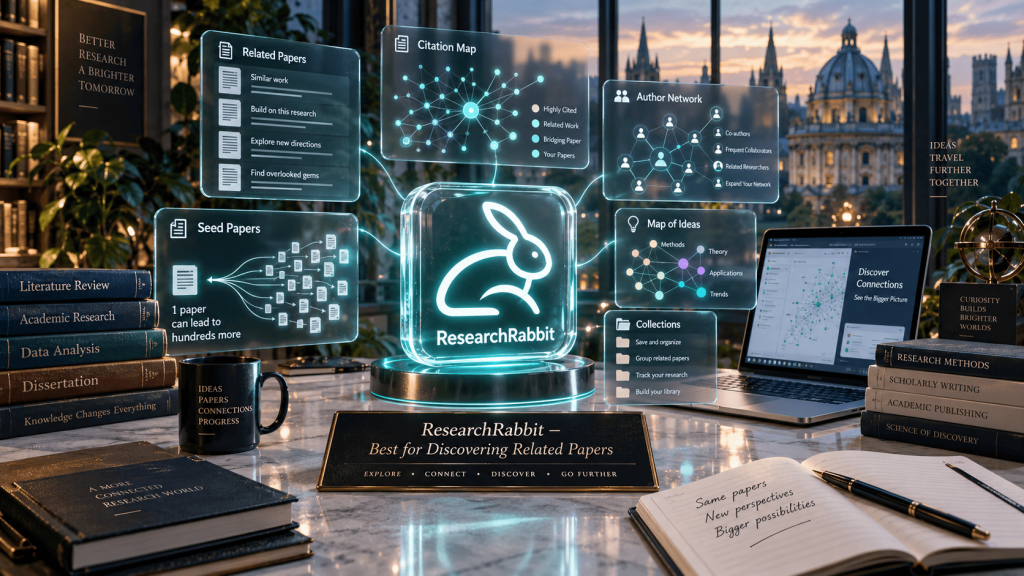
ResearchRabbit solves a different research problem: sometimes you have already found two or three excellent papers, but you do not know what else you should be reading.
Rather than giving you another ordinary list of keyword results, ResearchRabbit helps visualise relationships between papers, authors and citations. Its current database contains more than 310 million research articles, drawing metadata from sources including Crossref, Semantic Scholar and OpenAlex.
This is valuable when building a dissertation literature review because good research often develops through connections. One paper points backwards to foundational studies, forwards to newer work and sideways to related authors or debates that may never have appeared in your original keyword search.
A sensible workflow is to begin with several strong “seed” papers, use ResearchRabbit to explore their surrounding network and then return to your university library or academic databases to read and evaluate the most relevant material.
Best for: expanding a literature review from a small set of strong papers.
Watch out for: citation-network discovery should complement rather than replace systematic database and keyword searching.
Official source: ResearchRabbit – Database and Coverage
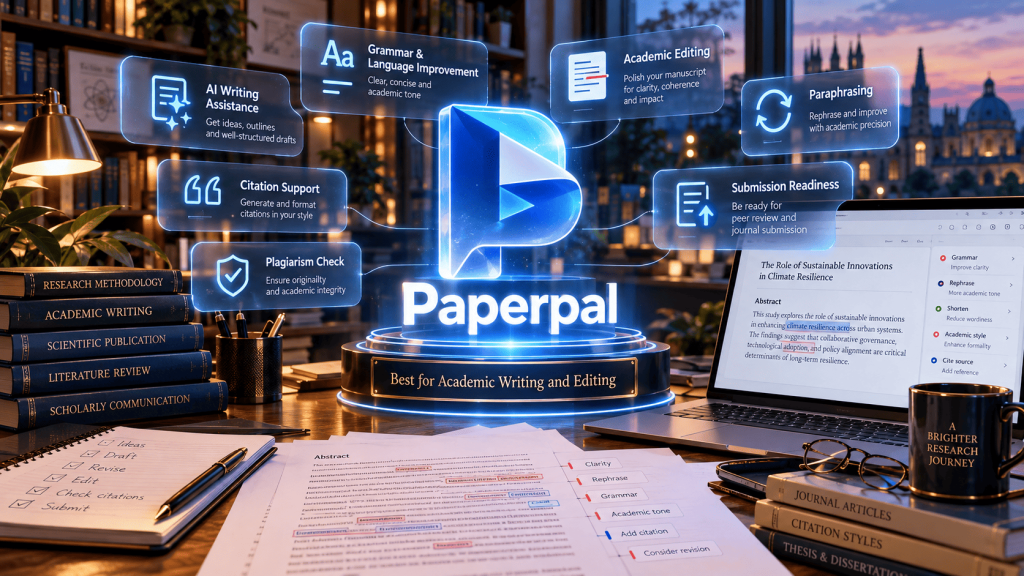
6. Paperpal – Best for Academic Writing and Editing
Paperpal differs from general writing assistants because it is built specifically around scholarly communication. It combines academic language editing with research and citation tools, making it useful when you already have a developing argument but need support turning it into clearer academic writing.
Paperpal currently states that its research tools can work with more than 250 million verified research articles and generate citations across 10,000+ styles. It also offers language and grammar checks, contextual rewriting, paraphrasing, reference discovery and tools for working with research PDFs.
For dissertation or thesis work, the strongest use is not asking the tool to invent the intellectual argument. It is using it to improve presentation once the argument, evidence and sources are already under your control. This may include shortening an overlong sentence, improving academic tone, finding inconsistent references or making a paragraph easier to follow. For students specifically comparing academic writing tools, this specialist focus can make Paperpal more relevant than a general content-generation platform when the main task is improving a dissertation, thesis or research paper.
Best for: academic editing, reference support and research-oriented writing.
Watch out for: polished language cannot rescue a weak argument or unsuitable evidence. Academic quality begins with the thinking.
Official source: Paperpal – Academic Writing Assistant
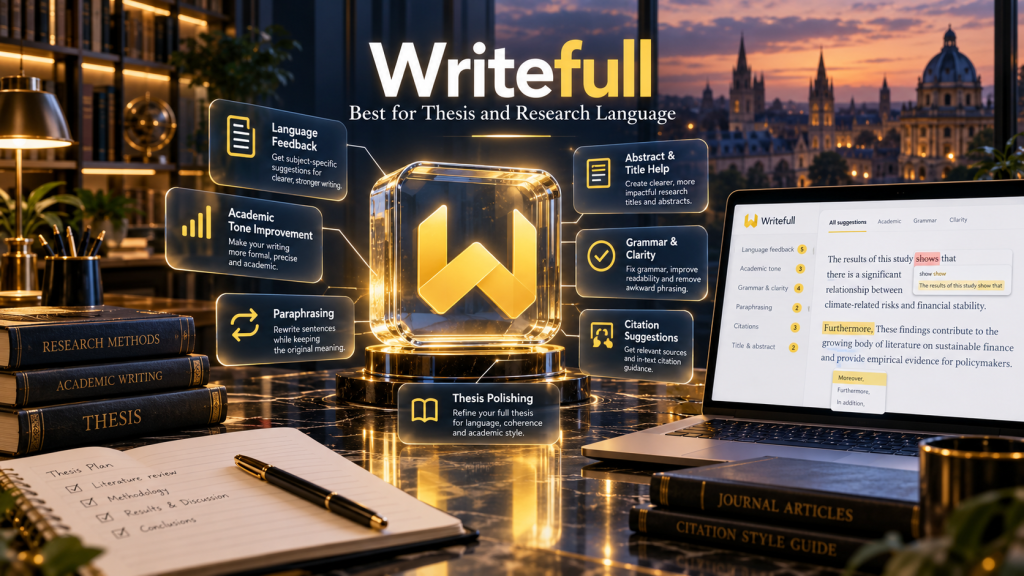
7. Writefull – Best for Thesis and Research Language
Writefull has an even narrower identity: it is designed around the language conventions of academic and research writing. The company states that its language models are trained on millions of journal articles, allowing its suggestions to follow patterns commonly found in scholarly communication.
That makes Writefull particularly useful for postgraduate students who already understand what they want to say but are struggling to express it in an appropriate academic register. It can help with grammar, academic phrasing, paraphrasing and sentence-level revision without being positioned primarily as a general research engine.
This distinction matters. A tool that improves how a methodology paragraph is written is not necessarily the right tool to decide whether the methodology itself is suitable.
If that is the problem you are dealing with, read ODA’s guide explaining what dissertation methodology is and how to choose it.
Best for: thesis, dissertation and research-paper language.
Watch out for: use it after you have made the substantive academic decisions rather than expecting language suggestions to supply the underlying argument.
Official source: Writefull – Academic Writing Tools
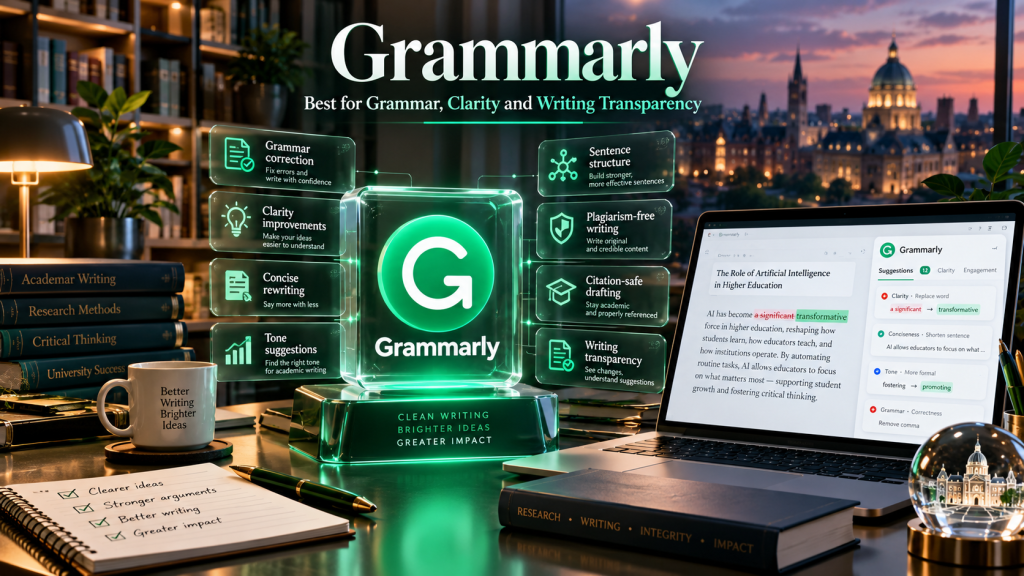
8. Grammarly – Best for Grammar, Clarity and Writing Transparency
Grammarly remains useful when the main problem is at sentence level: grammar, punctuation, clarity, awkward phrasing or consistency. It is particularly practical during the final editing stage, when the ideas and evidence are already present but the draft needs another pass for readability.
One feature worth understanding in 2026 is Grammarly Authorship. It is not simply an AI detector that inspects a finished document and guesses where text came from. When enabled during writing, Authorship tracks the composition process and categorises text based on how it entered the document, such as typed text, copied material or AI-generated material.
That distinction is important for students because claims about AI detection are often oversimplified. A process-tracking tool is fundamentally different from a detector making a probability judgement about completed prose.
Best for: final grammar, clarity and sentence-level revision.
Watch out for: do not accept every suggested rewrite automatically. A grammatically smoother sentence can still change technical meaning, legal terminology or the emphasis of an academic argument.
Official source: Grammarly Authorship

9. QuillBot – Best for Paraphrasing Support
QuillBot is most useful when you already understand an idea and want help expressing it more clearly or less repetitively. It can be particularly helpful when editing your own writing, shortening awkward wording or comparing alternative ways of phrasing a sentence.
The crucial academic-integrity point is that paraphrasing does not remove the need to cite a source. QuillBot’s own guidance states that if material from an external source is paraphrased, the original source still needs proper citation. It also states that its paraphrasing tool is not designed to bypass plagiarism-detection systems.
A sensible academic workflow therefore looks like this: read the original source, understand the argument, write the idea in your own discussion, check whether the phrasing can be improved and retain the appropriate citation. Feeding copied material through a paraphraser and treating the result as original thinking is not the same process.
For a broader explanation of referencing and responsible source use, see ODA’s guide to academic integrity and plagiarism in higher education.
Best for: rephrasing your own drafts and improving fluency.
Watch out for: automated paraphrasing can subtly change meaning. Always compare the revised sentence with what you originally intended to say.
Official source: QuillBot – Using a Paraphrasing Tool Responsibly

10. Perplexity – Best for Fast Source-Based Web Research
Perplexity is particularly useful at the beginning of a research task when you need to understand terminology, identify recent developments or discover sources worth investigating further. Its search products work across web sources and provide direct citations so users can follow claims back to their origin.
Perplexity’s current Pro Search documentation explains that it conducts multiple searches and synthesises information from sources including articles, academic papers and other web material, while allowing searches to be narrowed towards academic content. The company also advises users to validate information against the linked sources.
That makes it useful for orientation, particularly on fast-moving subjects. If you are researching a new law, technology development or policy change, Perplexity can help identify the vocabulary and current sources you need to investigate.
However, there is an important difference between source-based web research and a proper academic literature search. A dissertation literature review should still rely on peer-reviewed databases, library resources and original primary sources where appropriate.
Best for: quickly exploring unfamiliar or current subjects with visible source links.
Watch out for: do not mistake a convenient synthesis of web sources for a complete review of the scholarly literature.
Official source: Perplexity – Pro Search Explained
Best AI Tools for a Dissertation
A dissertation is too large for one AI tool to handle well from beginning to end. A better approach is to match the platform to the stage of the project.
During topic selection, ChatGPT can help turn a broad interest into several possible research questions, while ODA’s guide to choosing a strong dissertation topic can help you judge whether the scope is realistic. Once the research question is clearer, Elicit or Consensus can help identify relevant studies, ResearchRabbit can expand the literature around strong seed papers, and Scite can help you investigate how important studies have been treated by later research.
When the research and argument are in place, Paperpal, Writefull or Grammarly can be used more appropriately for language and editing. ChatGPT can also be useful for reviewing whether a chapter flows logically or whether an argument has an obvious gap, provided you retain control of the final judgement and check any factual or source-based claims.
In other words, the strongest dissertation workflow is not AI writes dissertation. It is different tools reduce friction at different stages while you remain responsible for the research, argument and final work.
Best AI Tools for a Literature Review
For literature reviews, the strongest combination in this comparison is Elicit + ResearchRabbit + Scite.
Elicit is useful for finding and organising relevant evidence. ResearchRabbit can help expand from important papers through citation and authorship connections. Scite then provides another layer by showing how particular studies have been treated in subsequent research.
ChatGPT or Consensus may be useful around this process for understanding themes or exploring research questions, but the literature review still needs your critical judgement. Two papers reaching different conclusions do not automatically mean the evidence is evenly balanced. You need to investigate their methods, samples, contexts and limitations.
That critical comparison is what turns a literature review from a list of summaries into an academic argument.
What Is the Best AI Combination for Students?
Most students do not need subscriptions to ten different AI platforms. Three or four well-chosen tools are usually more useful than constantly moving between systems.
For an ordinary university essay, ChatGPT may help with planning, Consensus or Elicit with finding evidence, Scite with checking important studies, and Grammarly or Paperpal with the final language. A research-heavy dissertation may benefit more from Elicit, ResearchRabbit and Scite alongside a flexible general assistant such as ChatGPT. Someone who has already completed the research but struggles with academic English may get greater value from Writefull or Paperpal than from adding another search platform.
The important distinction is between finding evidence, evaluating evidence, developing an argument and editing prose. Those are separate academic activities, even when modern AI platforms increasingly overlap.
Can UK University Students Use AI for Academic Writing?
AI use among UK university students is no longer unusual. The Higher Education Policy Institute’s Student Generative AI Survey 2026, based on responses from 1,054 full-time UK undergraduates, found that 95% had used AI in at least one way and 94% reported using generative AI to support assessed work. However, only 12% said they directly included AI-generated text in assessed work.
Those figures show why the important question in 2026 is no longer simply whether students use AI. It is how they use it and what their institution permits.
A university may allow AI for brainstorming, proofreading, coding support or explaining concepts while restricting generated text in assessed submissions. Another module may require students to disclose how AI was used. Rules may even vary between assessments within the same university.
Before using any AI tool for assessed work, check the instructions for your specific course and assessment. If the policy is unclear, ask the relevant tutor or academic department rather than assuming that a use permitted elsewhere is also permitted in your module.
UK source: HEPI – Student Generative AI Survey 2026
How to Use AI Without Weakening Your Academic Work
AI is most useful when it removes unnecessary friction without taking over the academic decisions you are meant to make. Using it to understand a difficult concept, identify search terms, organise notes or see where a paragraph is unclear can support learning. Using it as an unquestioned source of facts, citations or finished arguments creates very different risks.
Always return to the original source when a claim matters. Read the journal article rather than citing an AI summary of it. Check that a quotation actually appears in the source. Confirm that the methodology described by an AI tool matches the study. Keep track of which ideas came from published research and which are your own interpretation.
Most importantly, do not let smoother writing create the illusion of stronger scholarship. Academic work is assessed on far more than grammar. A polished dissertation with a vague research question, unsuitable methodology or descriptive literature review will still have fundamental weaknesses.
Getting Support With Academic Writing
AI can help identify a problem, but it does not always tell you why the problem matters academically. A literature review can contain dozens of relevant papers and still be too descriptive. A dissertation can be beautifully edited but built around an unmanageable research question. An assignment can be well referenced yet fail to answer the command verb in the assessment brief.
Online Dissertation Advisors provides academic support for university work including topic development, research questions, dissertation proposals, literature reviews, methodology, structure, academic feedback, editing and proofreading. The purpose is to help you strengthen your own research and academic work rather than replace your authorship.
If your research is already complete and the main problem is clarity, flow or academic presentation, you can also explore ODA’s editing and proofreading support.
Frequently Asked Questions
Q1. Which AI is best for academic writing?
There is no single best option for every academic task. ChatGPT is a strong general-purpose choice for planning, explanations and reviewing ideas. Paperpal and Writefull are more specialised for scholarly language, while Grammarly is useful for general grammar and clarity. If your main problem is finding academic evidence rather than improving prose, Elicit, Consensus or Scite may be more appropriate.
Q2. Which AI tool is best for a dissertation?
A dissertation usually benefits from more than one tool. ChatGPT can help with planning and question refinement, Elicit with literature discovery and evidence synthesis, ResearchRabbit with finding related papers, Scite with evaluating citation context, and Paperpal or Writefull with final academic language. The university’s AI policy should determine how each can be used in assessed work.
Q3. Which AI is best for literature reviews?
Elicit is one of the strongest specialist options for structured literature searching and evidence synthesis, especially where systematic-review methods are relevant. ResearchRabbit is useful for discovering connected studies, while Scite helps investigate whether important research has been supported, challenged or simply cited by later work.
Q4. What is the best free AI writing assistant for students?
The best free AI writing assistant depends on what you need help with. ChatGPT can be useful for planning, explanations and feedback, while free access offered by tools such as Grammarly, QuillBot, Elicit or Consensus may be more useful for specific tasks. Free plans and limits change regularly, so compare the current features rather than choosing only by the amount of free usage available.
Q5. Is ChatGPT good for academic research?
Yes, when it is used as a research assistant rather than treated as the final authority. ChatGPT can help develop research plans, compare sources, synthesise information and identify gaps, particularly when its search and research capabilities are used. Important claims, quotations and citations should still be checked against the underlying sources.
Q6. Which AI tools can find academic papers?
Elicit, Consensus, Scite, ResearchRabbit and Paperpal all work with scholarly literature in different ways. Elicit and Consensus are particularly useful for finding research around a question, ResearchRabbit is designed around connected literature, and Scite focuses strongly on citation relationships and evidence context.
Q7. What is the best free AI tool for students?
This depends on what you need, and free plans change regularly. Several tools in this guide offer some form of free access, but the limits and available features differ. Choose according to the task rather than simply selecting whichever tool offers the largest free allowance.
Q8. Can AI write my university assignment for me?
AI can technically generate long pieces of academic-looking text, but submitting generated work as your own may breach university academic-integrity rules and can also introduce inaccurate claims, invented references or weak reasoning. A safer and more educational use is to employ AI for permitted activities such as planning, understanding concepts, research support, revision and feedback while retaining responsibility for the submitted work.
Q9. Are AI-generated citations reliable?
Never assume they are. Even systems that provide source links should be checked against the original paper or publication before the citation is used academically. Confirm the author, title, date, publication details and, most importantly, whether the source actually supports the statement you are making.
Final Thoughts
The best AI tools for academic writing in 2026 are not necessarily the ones capable of generating the most text. The more useful distinction is whether a tool helps you think, find evidence, evaluate evidence or communicate your own argument more clearly.
ChatGPT offers the broadest flexibility. Elicit and Consensus make scholarly evidence easier to explore. Scite helps you interrogate what happened to a study after publication, while ResearchRabbit is excellent for discovering the literature surrounding papers you already trust. Paperpal and Writefull are more specialised for academic writing, Grammarly is useful for final language and writing transparency, QuillBot can support careful paraphrasing, and Perplexity is useful when quick, source-linked web research is needed.
None of them removes the need to read critically.
A credible university paper still depends on a focused question, appropriate evidence, sound methodology, accurate referencing and your own judgement about what the research actually means.
Use AI to make that process more efficient, not to remove the thinking that makes the work academic.
Ready to Elevate Your Grades?
Our Native UK Experts are standing by to help you with 100% original, high-quality work tailored to your exact requirements.