Understanding Academic Integrity
Academic integrity is the backbone of higher education. Think of it as the invisible contract between students, universities, and society. When a student submits an assignment, dissertation, or research paper, the institution expects that work to be original, honest, and ethically produced. Without integrity, academic qualifications lose their value. A university degree is not just about passing exams or collecting grades; it represents trust, knowledge, and intellectual effort.
In recent years, universities around the world have become increasingly concerned about academic misconduct. The rise of digital resources, essay mills, and artificial intelligence tools has created new challenges for students and educators alike. According to recent higher education reports, AI-related academic misconduct cases in universities have increased sharply over the past two years. Research published in 2026 highlighted that AI-assisted cheating incidents rose from 1.6 students per 1,000 in 2022–2023 to 7.5 students per 1,000 in 2024–2025. (MDPI)
Students often assume plagiarism only means copying an entire article from the internet. The reality is much broader. Academic misconduct can include improper paraphrasing, missing citations, unauthorized collaboration, buying assignments, or even reusing your previous work without permission. Universities now use sophisticated plagiarism detection systems, making it easier than ever to identify copied or AI-generated content.
At the same time, many students commit plagiarism unintentionally. They may not fully understand referencing rules, citation styles, or proper paraphrasing methods. This is especially common among first-year students and international students adapting to academic writing standards. The good news? Academic integrity is a skill that can be learned and strengthened with practice.
Why Academic Honesty Matters in University Life
Imagine building a house on weak foundations. It might look impressive for a while, but eventually, cracks appear. Academic dishonesty works the same way. Students who rely on copied work may achieve short-term success, but they often struggle later because they never truly develop research, writing, and analytical skills.
Higher education is designed to prepare students for professional life. Whether someone studies medicine, engineering, business, law, or social sciences, ethical behavior matters. Employers expect graduates to think critically, solve problems independently, and communicate honestly. A student who plagiarizes during university may carry unethical habits into their workplace, damaging their reputation and career prospects.
Universities also view academic integrity as essential for maintaining institutional credibility. If academic dishonesty becomes widespread, the value of degrees decreases. That is why many universities enforce strict disciplinary procedures. Some institutions issue warnings for first offenses, while others impose severe penalties, including failing grades, suspension, or expulsion.
The growing use of artificial intelligence has intensified these concerns. Recent surveys showed that over 90% of students now use AI tools in some form during their studies. (The Guardian) While AI can support brainstorming and research, universities increasingly warn students against submitting AI-generated content as original work. Many institutions now update academic integrity policies specifically to address generative AI.
Academic honesty also builds confidence. Students who produce original work develop a stronger understanding of their subjects. They learn how to argue ideas, evaluate evidence, and communicate effectively. Those skills are valuable far beyond university classrooms. In many ways, academic integrity is less about avoiding punishment and more about becoming a trustworthy professional and thinker.
What Is Plagiarism?
Plagiarism is the act of presenting someone else’s words, ideas, research, or creative work as your own without proper acknowledgment. It sounds simple on paper, but plagiarism exists in several forms, and some are surprisingly easy to commit accidentally.
Direct Plagiarism
Direct plagiarism is the most obvious type. This happens when a student copies text word-for-word from a source without quotation marks or citations. Universities treat this seriously because it demonstrates deliberate dishonesty. Even copying a few paragraphs from a website or journal article can trigger plagiarism detection software.
Self-Plagiarism
Many students are shocked to learn that reusing their own previous work can also count as misconduct. Self-plagiarism occurs when students submit the same assignment, essay, or research content for multiple courses without permission. Universities expect every assessment to represent fresh academic effort unless explicitly approved otherwise.
Mosaic and Accidental Plagiarism
Mosaic plagiarism happens when students patch together phrases or ideas from different sources while slightly changing wording. Even though the text may appear “rewritten,” the original structure and meaning remain too close to the source. Accidental plagiarism is equally common and often results from poor note-taking, forgotten citations, or misunderstanding referencing rules.
A major challenge today is the blurred line between AI assistance and plagiarism. Studies published in 2025 and 2026 explored how students increasingly use AI writing tools during academic work. (Springer) Universities now emphasize that simply generating text through AI and submitting it unchanged may violate academic integrity policies.
The important thing to remember is this: plagiarism is not only about intention. Universities usually judge the submitted work itself. Even if a student did not mean to cheat, missing citations or improper paraphrasing can still result in penalties.
Common Causes of Academic Misconduct
Students rarely wake up one morning and decide to become academically dishonest. In most cases, plagiarism grows out of stress, confusion, or desperation. Understanding these causes can help students avoid falling into common traps.
One major reason is poor time management. University life is demanding. Students juggle lectures, deadlines, part-time jobs, internships, and personal responsibilities. When deadlines pile up, panic often sets in. A student who planned to spend two weeks researching an essay may suddenly find themselves finishing it the night before submission. Under pressure, copying material from online sources may seem like an easy shortcut.
Another common factor is the pressure to achieve high grades. Many students feel intense competition from peers, parents, scholarships, or career expectations. In highly competitive academic environments, some students begin prioritizing grades over learning. This mindset creates fertile ground for plagiarism and cheating.
Misunderstanding academic writing conventions also contributes significantly. Citation styles like APA, Harvard, MLA, and Chicago can feel confusing at first. Students may not know when to cite paraphrased ideas, how to format references, or how to integrate quotations correctly. Without proper guidance, accidental plagiarism becomes more likely.
Technology has added another layer of complexity. AI tools can generate essays, summaries, and citations within seconds. While these tools offer convenience, they can also encourage overreliance. Some students mistakenly assume AI-generated content is automatically plagiarism-free. In reality, universities increasingly recognize AI misuse as academic misconduct. Reports from UK universities in 2025 showed thousands of confirmed cases involving AI-assisted cheating. (The Times)
There is also a psychological element. Students who feel disconnected from their studies or unsupported by instructors may justify dishonest behavior more easily. Research from 2026 found that unclear institutional rules and peer behavior strongly influenced students’ willingness to misuse AI tools academically.
The Role of AI Tools in Academic Integrity (2026 UPDATE)
Artificial intelligence has transformed education faster than most universities expected. Tools like OpenAI’s ChatGPT can explain concepts, summarize research articles, generate outlines, and even write full essays. For students, this feels revolutionary. For universities, it creates both opportunities and risks.
The big question students ask is simple: Is using AI considered plagiarism? The answer depends on how the tool is used and what university policies allow. Many institutions permit AI for brainstorming, grammar checking, or idea generation. Problems arise when students submit AI-generated content as their own original work.
A growing number of universities now include AI-specific guidance in their academic integrity policies. Some instructors require students to disclose AI usage, while others prohibit AI-generated writing entirely for certain assessments. Because policies vary widely, students must carefully read module handbooks and university guidelines before using AI tools.
Another concern is the reliability of AI-generated information. AI systems sometimes create fake references, inaccurate statistics, or misleading arguments. Students who blindly trust generated content risk submitting factually incorrect work. Imagine citing a source that does not actually exist. That alone could raise red flags during marking.
AI detection software has also become controversial. Some students have reported false accusations after plagiarism tools incorrectly flagged human-written work as AI-generated. (Reddit) Experts continue debating the accuracy of these systems, and several universities remain cautious about relying solely on automated AI detection scores.
The safest approach is transparency and moderation. AI should support learning, not replace it. Students can use AI tools to clarify difficult concepts or organize ideas, but the final analysis, argument, and writing should remain genuinely theirs. Think of AI as a calculator for writing: helpful when used correctly, problematic when it replaces actual understanding.
How Referencing Protects Your Academic Work
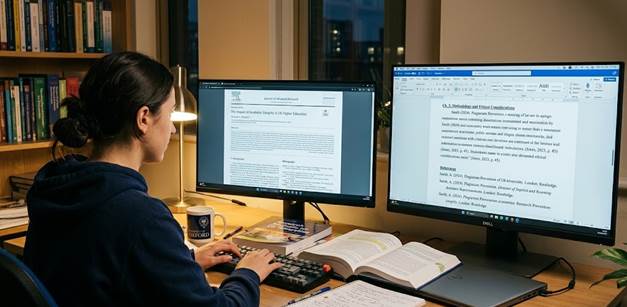
Referencing might seem tedious, but it is one of the most powerful tools students have against plagiarism accusations. Citations show where information comes from and demonstrate that students have engaged with credible academic sources. Proper referencing also strengthens arguments by connecting them to established research.
Different universities and disciplines use different citation styles. Understanding these systems is essential for academic success.
| Referencing Style | Common Subjects | Key Feature |
| APA | Psychology, Social Sciences | Author-date citations |
| Harvard | Business, Humanities | Flexible author-date format |
| MLA | Literature, Arts | Author-page citations |
| Chicago | History, Publishing | Notes and bibliography system |
APA Referencing
APA style is widely used in psychology, education, and social sciences. It emphasizes clarity and consistency. In-text citations usually include the author’s surname and publication year. Students often struggle with formatting reference lists correctly, but mastering APA becomes easier with consistent practice.
Harvard Referencing
Harvard referencing is one of the most common systems in UK universities. It follows an author-date format similar to APA but varies slightly depending on institutional guidelines. Many plagiarism cases occur simply because students misunderstand Harvard citation formatting.
MLA and Chicago Styles
MLA style is common in literature and humanities, while Chicago style frequently appears in history and publishing. Chicago referencing often uses footnotes instead of parenthetical citations, making it visually different from other systems.
Referencing is not just a technical requirement. It reflects academic respect. By acknowledging sources, students participate honestly in scholarly conversations rather than pretending ideas originated entirely from them.
Practical Ways Students Can Avoid Plagiarism
Avoiding plagiarism is less about fear and more about building strong academic habits. The students who consistently produce original work usually follow clear research and writing processes rather than relying on last-minute panic.
One of the most effective techniques is organized note-taking. Students should clearly separate their own thoughts from copied research notes. Using different colors, labels, or folders can help prevent confusion later when writing assignments. Many accidental plagiarism cases happen because students forget which sentences came directly from sources.
Paraphrasing is another critical skill. Good paraphrasing involves understanding the original idea fully and then explaining it naturally in your own words while still citing the source. Simply replacing a few words with synonyms is not enough. Universities and plagiarism software can often detect shallow rewriting.
Time management also plays a huge role. Starting assignments early gives students enough time to research, draft, edit, and reference properly. Rushed writing increases mistakes dramatically. A well-planned essay usually contains stronger arguments and fewer citation errors.
Students should also use plagiarism detection tools responsibly. Tools like Turnitin can help identify missing citations or overly similar wording before submission. However, plagiarism scores should never become an obsession. A low similarity percentage does not automatically guarantee originality, and a higher percentage may simply reflect properly cited quotations.
Seeking help is another smart strategy. Universities provide writing centers, librarians, academic advisors, and referencing workshops specifically to support students. Asking questions early can prevent serious problems later.
The key is developing confidence in your own thinking. Students sometimes plagiarize because they believe their ideas are not “good enough.” In reality, universities value independent analysis and critical engagement more than perfect wording.
Consequences of Academic Misconduct
The consequences of plagiarism can be severe, and many students underestimate the long-term impact. Universities take academic integrity seriously because dishonesty undermines educational standards and institutional credibility.
Academic penalties vary depending on the seriousness of the offense. Minor cases may result in reduced marks or mandatory rewriting. More serious violations can lead to failing modules, suspension, or expulsion. Research-based degrees such as master’s dissertations and PhDs face particularly strict scrutiny because originality is central to academic research.
Some universities also maintain permanent disciplinary records. This means academic misconduct may continue affecting students long after graduation. Scholarship applications, postgraduate admissions, and professional licensing bodies sometimes ask about disciplinary history.
Career damage is another overlooked consequence. Employers increasingly value integrity and ethical conduct. Imagine applying for a teaching, legal, or healthcare role while carrying a record of academic dishonesty. Trust is difficult to rebuild once broken.
The emotional toll can also be enormous. Students accused of plagiarism often experience stress, embarrassment, and anxiety. Investigations can feel overwhelming, especially if accusations involve AI detection tools or misunderstood referencing errors.
Cases involving AI misuse continue rising globally. One 2026 report highlighted that over 95% of certain PhD theses reviewed at an Indian university were flagged for plagiarism concerns involving copied or AI-assisted content. These developments show how seriously universities are approaching originality in the digital age.
Academic misconduct may seem like a shortcut, but shortcuts in education often create much longer and more painful journeys later.
Building a Culture of Academic Integrity
Academic integrity should not exist only as a set of university rules hidden inside policy documents. Ideally, it becomes part of a student’s mindset and daily academic behavior. When students value originality and honesty, they develop stronger learning habits and greater intellectual confidence.
Developing ethical research habits starts with curiosity. Students who genuinely engage with their subjects are less likely to plagiarize because they care about contributing meaningful ideas. Reading critically, asking questions, and participating in discussions naturally encourage independent thinking.
Collaboration also matters. Universities should create supportive learning environments where students feel comfortable seeking help instead of hiding struggles. Many plagiarism cases happen because students feel isolated or overwhelmed. Open communication with lecturers and tutors can reduce that pressure significantly.
Students should also learn to view feedback positively. Academic writing is a skill built over time through revision and improvement. Receiving criticism on structure, referencing, or argumentation is part of the learning process, not a personal failure.
Digital literacy has become increasingly important as well. Students need guidance on using AI tools ethically, evaluating online sources, and understanding plagiarism software limitations. Educational institutions worldwide are still adapting policies to address rapidly changing technologies. (Springer)
Integrity ultimately benefits students themselves. Original work builds authentic knowledge, stronger communication skills, and professional credibility. Degrees earned honestly carry genuine confidence because students know they truly developed the expertise behind their qualifications.
Conclusion
Academic integrity is far more than avoiding punishment or passing plagiarism checks. It represents honesty, responsibility, and respect for learning. In higher education, originality matters because universities exist to develop independent thinkers capable of contributing meaningful ideas to society.
The rise of AI tools, online resources, and digital learning platforms has made academic writing more complicated than ever before. Students now navigate a landscape where the line between assistance and misconduct can sometimes feel blurry. That is why understanding plagiarism, referencing, paraphrasing, and ethical AI usage has become essential for academic success.
Students who manage time effectively, reference carefully, and trust their own thinking place themselves in a much stronger position academically and professionally. Mistakes can happen, especially during the early stages of university life, but awareness and good habits dramatically reduce the risk of academic misconduct.
At its core, academic integrity is about authenticity. A degree earned honestly reflects real knowledge, genuine effort, and personal growth. Those qualities continue to matter long after graduation.
Frequently Asked Questions (FAQs)
1. What is a “safe” similarity percentage on Turnitin?
Safe percentage does not exist. A 15% score could be fine if it consists of properly cited references. A 5 point score may be plagiarism where it is a single paragraph without a source. It does not matter how many people read the report, but how good the report is.
2. Is it plagiarism if I use my own old assignments?
Yes, this is referred to as self-plagiarism. One cannot get a credit on the same work twice. Should you wish to elaborate on your past composition, then you would have to cite yourself like any other writer.
3. What are the penalties of plagiarism?
The penalties vary between a formal warning with a mark of zero on the assignment and being expelled from the university and loss of past credits. It may also make you ineligible to professional organizations (such as law or medicine).
4. How do I cite a source I found inside another book?
This is a “secondary citation.” You should write: (Smith, 2020, cited in Jones, 2023). However, tutors of the UK would want you to try to locate the original text of Smith (2020) to be accurate.
5. Can I use an AI tool to translate my dissertation?
Although translation tools can be useful, you will need to reveal their use in case they substantially change the wording of your research. Always ensure you have reviewed the particular policy on AI translation in your university.
Ready to Elevate Your Grades?
Our Native UK Experts are standing by to help you with 100% original, high-quality work tailored to your exact requirements.