

Criminal law rarely suffers from a shortage of interesting problems.
The harder question is whether an interesting problem can survive 8,000 or 10,000 words of legal scrutiny.
“Cybercrime” may sound current, but it is far too large for a dissertation. “Sentencing reform” has the same problem. A useful criminal law dissertation topic needs something more precise: a disputed legal principle, an uncertain boundary of liability, a recent statutory change, a reform proposal, or a conflict between individual rights and the demands of criminal justice.
The 2026/27 academic year is particularly rich in such questions. The Law Commission is conducting a major review of homicide law, criminal appeals reform is moving towards final recommendations, the Government has responded to concerns about criminal disclosure in the digital age, new offences address AI-generated intimate images, and the UK’s latest fraud strategy is responding to increasingly technology-enabled offending.
This guide contains 31 criminal law dissertation ideas suitable for LLB and LLM research, with suggested questions, methodological direction and an explanation of why each subject is worth investigating.
Legal update: The legislation, consultations and law-reform projects discussed below were checked in August 2026. Criminal law changes quickly. Confirm the current status of any Bill, consultation, commencement provision or reform project before submitting your final dissertation proposal.
Quick Answer: 10 Strong Criminal Law Dissertation Topics for 2026/27
If you want the strongest current ideas first, begin with these:
- Should murder be divided into first- and second-degree offences?
- Does the mandatory life sentence for murder remain justified?
- Does the criminal appeals system adequately correct miscarriages of justice?
- Should the Criminal Cases Review Commission referral test be reformed?
- Is criminal disclosure law capable of dealing with enormous volumes of digital evidence?
- Are existing laws adequate for AI-enabled fraud and cybercrime?
- Do the new deepfake intimate-image offences provide sufficient protection?
- Is the M’Naghten insanity test fit for modern criminal law?
- Has the failure-to-prevent-fraud offence created a better model of corporate criminal liability?
- Are police uses of facial-recognition technology compatible with privacy and equality rights?
Several of these subjects are unusually timely. The Law Commission’s June 2026 homicide consultation proposes significant restructuring of homicide offences, including a possible three-tier structure of first-degree murder, second-degree murder and manslaughter. Further work on homicide defences and sentencing is expected in 2027.
Find a Criminal Law Topic by Interest
| If You Are Interested In… | Best Area to Explore | Typical Level |
|---|---|---|
| Murder and criminal responsibility | Homicide reform | LLB / LLM |
| Wrongful convictions | Appeals and CCRC reform | LLB / LLM |
| AI and technology | Deepfakes, fraud, digital evidence | LLB / LLM |
| Hacking and online crime | Cybercrime | LLB / LLM |
| Sexual offences | Consent and intimate images | LLB / LLM |
| Punishment | Sentencing and rehabilitation | LLB / LLM |
| Business crime | Fraud and corporate liability | Advanced LLB / LLM |
| Civil liberties | Police powers and surveillance | LLB / LLM |
| Mental condition defences | Insanity and automatism | LLB / LLM |
The labels are guides rather than rules. A narrow LLB project can be intellectually demanding, while an LLM project still needs a manageable question.
How to Choose a Criminal Law Dissertation Topic
A good criminal law topic normally has four things.
A clear legal question
“Cybercrime in the UK” is an area of interest. “Is the Computer Misuse Act 1990 capable of addressing contemporary ransomware offending?” is a research question.
Enough primary authority
Look for relevant:
- statutes.
- cases.
- sentencing guidelines.
- prosecution guidance.
- consultation papers.
- parliamentary materials.
- official reform proposals.
Genuine disagreement
A dissertation becomes more interesting when reasonable arguments exist on both sides.
A manageable scope
A dissertation is not a complete history of criminal law.
If you need a fuller process for narrowing a broad idea, ODA’s How to Choose a Strong Dissertation Topic guide should be used alongside this specialist criminal-law list.

Homicide and Criminal Responsibility Dissertation Topics
Homicide is one of the strongest criminal-law areas for 2026-27.
The Law Commission opened a major consultation on homicide offences on 17 June 2026, with responses invited until 30 September 2026. Its provisional proposals seek to align homicide offences more closely with culpability and proportionate sentencing. Further consultation on homicide defences and sentencing for murder is planned for 2027.
That gives current students something valuable: established case law combined with live reform.
1. Should Murder Be Divided Into Degrees?
Possible research question:
Would replacing the existing murder/manslaughter structure with degrees of murder produce a more coherent relationship between culpability and criminal liability?
Suitable for: LLB / LLM
Method: Doctrinal / law-reform analysis
Current relevance: Exceptional
The Law Commission’s current proposals include possible first-degree murder, second-degree murder and manslaughter categories.
A dissertation could examine:
- intention to kill;
- intention to cause serious injury;
- culpability;
- fair labelling;
- partial defences;
- sentencing consequences; and
- whether a tiered structure would genuinely improve the present law.
This is one of the strongest criminal law dissertation topics available for 2026.
2. Is the Mandatory Life Sentence for Murder Still Justified?
Possible research question:
Does the mandatory life sentence for murder permit sufficiently proportionate punishment across materially different levels of culpability?
Suitable for: LLB / LLM
Method: Doctrinal / sentencing theory
Two defendants convicted of murder may have acted in very different circumstances.
A strong dissertation could consider:
- culpability;
- proportionality;
- minimum terms;
- judicial discretion;
- partial defences;
- public protection; and
- the symbolic importance attached to murder.
The subject will become even more current as the Law Commission moves into the sentencing strand of its homicide review in 2027.
3. Does Loss of Control Work Fairly in Domestic-Abuse Cases?
Possible research question:
Does the loss-of-control defence adequately recognise the circumstances of defendants subjected to prolonged domestic abuse?
Suitable for: LLB / LLM
Method: Doctrinal
This is much more manageable than a general dissertation on voluntary manslaughter.
Possible areas include:
- qualifying triggers;
- fear of serious violence;
- the loss-of-control requirement;
- gendered assumptions;
- delayed reactions;
- domestic abuse; and
- the relationship between legal doctrine and lived experience.
It also offers a natural route into the wider homicide reform debate.
4. Should the Insanity Defence Be Replaced?
Possible research question:
Is the M’Naghten test compatible with modern understandings of mental disorder and criminal responsibility?
Suitable for: LLB / LLM
Method: Doctrinal
Current relevance: High
The basic legal framework governing insanity dates from 1843. The Law Commission describes the existing rules as unclear in places, poorly aligned with psychiatric understanding and difficult to reconcile with the law on automatism. A new insanity project forms part of its 14th Programme of Law Reform, although substantive work has not yet begun.
That combination of old doctrine and prospective reform makes this a particularly good dissertation subject.
5. Is the Distinction Between Insane and Non-Insane Automatism Coherent?
Possible research question:
Does the distinction between insane and non-insane automatism produce principled outcomes in English criminal law?
Suitable for: LLB / LLM
Method: Doctrinal
Possible issues include:
- internal and external causes
- epilepsy
- diabetes
- mental conditions
- voluntariness
- criminal responsibility
- the consequences of different verdicts
This is narrower than a complete dissertation on insanity and may therefore be easier to control.
Criminal Appeals and Miscarriages of Justice Topics
A criminal-justice system must be capable of correcting its own mistakes.
How easily it should do so is far less simple.
The Law Commission’s criminal appeals project examines the tests used by appeal courts and the Criminal Cases Review Commission, access to post-trial evidence, compensation and support for people whose convictions are quashed. Its final main report is currently expected in early 2027, with a separate report on compensation and support expected before the end of 2026.
6. Is the Criminal Appeal “Safety” Test Too Restrictive?
Possible research question:
Does the current approach to determining whether a conviction is unsafe provide an effective safeguard against miscarriages of justice?
Suitable for: LLB / LLM
Method: Doctrinal / institutional analysis
Current relevance: Very high
Possible areas include:
- wrongful conviction;
- fresh evidence;
- errors at trial;
- appellate restraint;
- finality of proceedings; and
- the corrective role of the Court of Appeal.
7. Should the CCRC Referral Test Be Reformed?
Possible research question:
Does the Criminal Cases Review Commission’s “real possibility” test make it unnecessarily difficult to refer potential miscarriages of justice to the Court of Appeal?
Suitable for: LLB / LLM
Method: Doctrinal / policy analysis
Top pick: Yes
The Law Commission is specifically reviewing the CCRC and its referral test.
This gives the dissertation a clear institutional focus rather than requiring an examination of the entire appeals system.
8. Access to Evidence After Conviction
Possible research question:
Does English criminal procedure provide convicted defendants with adequate access to retained evidence when seeking to establish a miscarriage of justice?
Suitable for: LLM / advanced LLB
Method: Doctrinal / procedural
Potential issues include:
- evidence retention;
- forensic material;
- disclosure after trial;
- technological developments;
- defence access; and
- finality versus factual innocence.
9. Compensation for the Wrongly Convicted
Possible research question:
Does the current compensation framework provide an adequate remedy for people whose wrongful convictions are overturned?
Suitable for: LLB / LLM
Method: Doctrinal / human-rights analysis
The Law Commission intends to report separately on compensation and support for the wrongly convicted during 2026.
That gives this familiar justice question a strong contemporary hook.
AI, Cybercrime and Digital Evidence Dissertation Topics
Technology changes quickly.
Criminal-law principles tend to move more slowly. The useful dissertation question is usually found in the gap between the two.
10. AI-Enabled Fraud and Existing Criminal Liability
Possible research question:
Are existing fraud offences capable of addressing offending carried out at scale through generative artificial intelligence?
Suitable for: LLB / LLM
Method: Doctrinal
Potential examples include:
- AI-assisted impersonation;
- synthetic voices;
- automated phishing;
- fraudulent content generation;
- deception at scale; and
- questions of attribution and intent.
The Government’s Fraud Strategy 2026–2029 expressly recognises technology-enabled fraud and places increased emphasis on disrupting the tools and systems criminals use.
11. Is the Computer Misuse Act 1990 Still Fit for Purpose?
Possible research question:
Can the Computer Misuse Act 1990 provide an adequate criminal-law response to modern cyber offending?
Suitable for: LLB / LLM
Method: Doctrinal / law-reform analysis
Possible areas include:
- unauthorised access;
- malware;
- ransomware;
- security research;
- territorial jurisdiction;
- modern hacking techniques; and
- whether older statutory language remains suitable for today’s digital environment.
This is an example of an older statute producing a very modern dissertation.
12. Cross-Border Cybercrime and Jurisdiction
Possible research question:
How effectively can the criminal law of England and Wales respond to cyber offences committed across several jurisdictions?
Suitable for: LLM / advanced LLB
Method: Doctrinal / comparative
A cyberattack may involve:
- an offender in one country;
- infrastructure in another;
- victims in several others;
- cryptocurrency transfers across multiple jurisdictions.
That creates difficult questions about territorial jurisdiction, enforcement and international cooperation.
13. Ransomware and Criminal-Law Enforcement
Possible research question:
Does the existing criminal-law framework provide an effective response to ransomware offending and ransom payments?
Suitable for: LLB / LLM
Method: Doctrinal / policy analysis
Possible themes include:
- computer misuse;
- blackmail;
- money laundering;
- cryptocurrency;
- corporate victims;
- payment of ransom demands; and
- international enforcement.
14. Digital Disclosure in Criminal Proceedings
Possible research question:
Is the criminal disclosure regime capable of dealing fairly and efficiently with the volume of digital evidence generated in modern investigations?
Suitable for: LLB / LLM
Method: Doctrinal / procedural
Current relevance: Exceptional
The Government published Modernising the Criminal Disclosure Regime on 14 July 2026, responding to reviews of disclosure in the digital age and disclosure within the criminal courts.
This gives students an unusually current question involving:
- unused prosecution material;
- mobile-phone data;
- digital communications;
- AI-assisted document review;
- fair-trial rights;
- prosecution duties;
- defence access; and
- enormous datasets.
15. Deepfake Evidence in Criminal Trials
Possible research question:
Are existing evidential safeguards sufficient to authenticate audio and video evidence in an age of convincing AI-generated deepfakes?
Suitable for: LLB / LLM
Method: Doctrinal / evidence law
The important question is not whether AI-generated media exists.
It plainly does.
The legal question is how courts should decide whether material is authentic, reliable and fairly admissible when realistic manipulation becomes easier to produce.

Sexual Offences, Consent and Intimate Images
Sexual-offences law sits at an especially difficult point between autonomy, evidence, fair-trial rights and protection from harm.
Recent technological change has made those tensions sharper.
16. Non-Consensual AI-Generated Intimate Images
Possible research question:
Do the new offences concerning AI-generated intimate images provide an adequate criminal-law response to non-consensual sexual deepfakes?
Suitable for: LLB / LLM
Method: Doctrinal
Current relevance: Exceptional
Section 138 of the Data (Use and Access) Act 2025 introduced offences of creating, or requesting the creation of, purported intimate images of an adult without consent or reasonable belief in consent. Those offences came into force on 6 February 2026.
The Crime and Policing Act 2026 has since added an offence concerning making or supplying generators designed to create purported intimate images. CPS guidance now reflects these developments.
A dissertation could examine:
- consent;
- synthetic sexual imagery;
- reasonable excuse;
- criminalisation of creation rather than distribution;
- enforcement;
- generator tools; and
- proportionality.
17. Consent Under the Sexual Offences Act 2003
Possible research question:
Does the statutory concept of consent under section 74 of the Sexual Offences Act 2003 provide sufficient certainty in difficult sexual-offence cases?
Suitable for: LLB / LLM
Method: Doctrinal
The Law Commission has identified consent in criminal law as a future law-reform project, noting continuing complexity and inconsistency despite statutory developments including the Sexual Offences Act 2003. Work on the project has not yet commenced.
That distinction matters: this is a planned reform project, not an active consultation.
18. Deception and Sexual Consent
Possible research question:
When should deception be capable of invalidating consent for the purposes of sexual offences?
Suitable for: LLB / LLM
Method: Doctrinal
Possible areas include deception about:
- identity;
- purpose;
- contraception;
- sexual health;
- nature of the act; and
- other circumstances influencing agreement.
This gives a broad philosophical question a manageable legal framework.
19. Complainant Privacy and Digital Evidence
Possible research question:
Does the use of complainants’ digital communications in sexual-offence investigations strike a fair balance between privacy and the defendant’s right to a fair trial?
Suitable for: LLB / LLM
Method: Doctrinal / human-rights analysis
This connects:
- disclosure;
- privacy;
- mobile-phone extraction;
- Article 8;
- Article 6;
- evidential relevance; and
- victim participation.
It is considerably stronger than the vague “role of digital evidence in sexual offence prosecutions”.
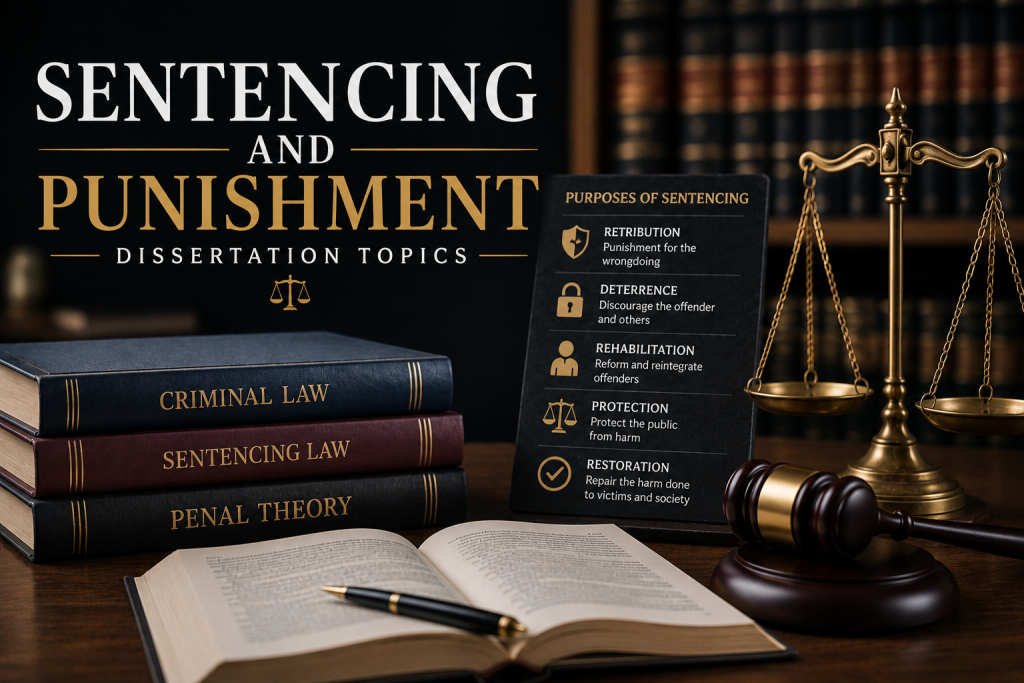
Sentencing and Punishment Dissertation Topics
Sentencing topics can easily drift into criminology.
For a criminal law dissertation, keep the legal framework at the centre.
20. Judicial Discretion and Sentencing Guidelines
Possible research question:
Do sentencing guidelines reduce unjustified inconsistency without placing excessive restrictions on judicial discretion?
Suitable for: LLB
Method: Doctrinal / sentencing analysis
This gives you a genuine legal tension:
consistency versus individualised justice.
A dissertation could examine a specific offence or category rather than attempting the whole sentencing system.
21. Whole-Life Orders
Possible research question:
Are whole-life orders compatible with principles of proportionality, human dignity and rehabilitation?
Suitable for: LLB / LLM
Method: Doctrinal / human-rights analysis
Possible areas include:
- punishment;
- public protection;
- proportionality;
- Article 3 ECHR;
- review mechanisms; and
- the place of rehabilitation in sentencing theory.
22. Rehabilitation as a Sentencing Objective
Possible research question:
Does the statutory sentencing framework give sufficient weight to rehabilitation when dealing with repeat offending?
Suitable for: LLB / LLM
Method: Doctrinal / socio-legal
This is the better legal version of:
“Do rehabilitation programmes reduce reoffending?”
The latter is primarily an empirical criminology question.
Here, the focus remains on the law and principles governing sentencing.
23. Sentencing Young Adults
Possible research question:
Should sentencing law recognise young adulthood as a distinct category of reduced developmental maturity?
Suitable for: LLB / LLM
Method: Doctrinal / interdisciplinary
This offers room to examine:
- culpability;
- maturity;
- neuroscience;
- proportionality;
- rehabilitation; and
- the boundary between youth and adult justice.
Corporate and Economic Crime Dissertation Topics
The old assumption that criminal responsibility belongs naturally to an individual offender becomes much harder when wrongdoing occurs inside a large organisation.
Recent fraud reform makes this a particularly useful field.
24. Failure to Prevent Fraud
Possible research question:
Has the failure-to-prevent-fraud offence created a more effective model of corporate criminal responsibility?
Suitable for: Advanced LLB / LLM
Method: Doctrinal / corporate crime
Current relevance: Very high
The offence came into force on 1 September 2025. It applies to large organisations where an associated person commits specified fraud intending to benefit the organisation or certain connected persons, unless the organisation can establish the relevant prevention defence.
Possible issues include:
- organisational fault;
- associated persons;
- prevention procedures;
- deterrence;
- corporate culture; and
- whether failure-to-prevent offences provide a better approach than traditional attribution rules.
25. Corporate Attribution and Senior Managers
Possible research question:
Do modern corporate-attribution rules make it sufficiently practical to prosecute large companies for economic crime?
Suitable for: LLM / advanced LLB
Method: Doctrinal
This is an excellent topic for someone interested in the boundary between company law and criminal law.
The core question is simple:
When a large organisation commits wrongdoing through human decision-makers, whose knowledge and conduct should count as the company’s?
26. The Fraud Strategy 2026–2029
Possible research question:
Does the UK’s Fraud Strategy 2026–2029 place an appropriate balance between criminal enforcement and upstream crime prevention?
Suitable for: LLM / policy-focused LLB
Method: Policy / criminal justice analysis
The Government’s current strategy is organised around disrupt, safeguard and respond, with significant emphasis on preventing fraud before it occurs, cross-sector cooperation, technology and improved victim support.
This is especially suitable for someone who wants a dissertation sitting between substantive criminal law and criminal-justice policy.
27. Cryptocurrency and Proceeds of Crime
Possible research question:
Are existing confiscation and money-laundering powers adequate for criminal proceeds held in cryptoassets?
Suitable for: LLM / advanced LLB
Method: Doctrinal
Potential issues include:
- tracing;
- seizure;
- confiscation;
- anonymity;
- decentralised transactions;
- cross-border enforcement; and
- valuation.
Keep the focus on criminal proceeds rather than attempting the whole field of cryptocurrency regulation.
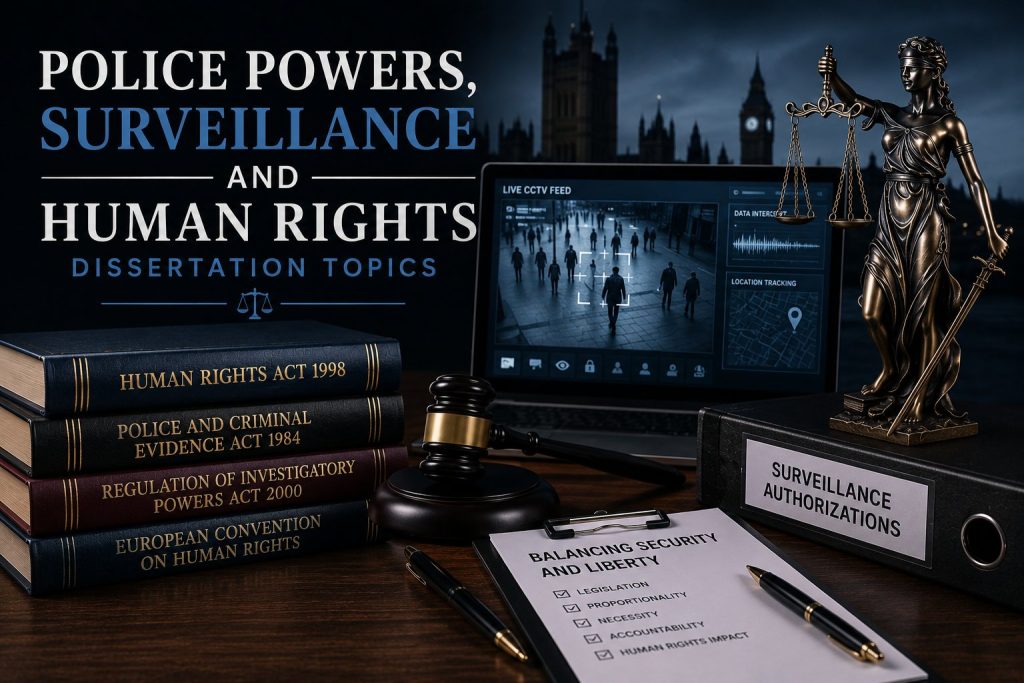
Police Powers, Surveillance and Human Rights Topics
Criminal law does not operate only through offences.
It also determines how far the state may go when investigating them.
28. Live Facial Recognition by Police
Possible research question:
Does the legal framework governing police use of live facial recognition provide sufficient safeguards for privacy and equality?
Suitable for: LLB / LLM
Method: Doctrinal / public-law analysis
Possible issues include:
- Article 8 ECHR;
- biometric data;
- discrimination;
- proportionality;
- police discretion;
- transparency; and
- oversight.
This is considerably stronger than a general dissertation about “technology in police investigations”.
29. Digital Searches of Mobile Phones
Possible research question:
Do existing criminal-investigation powers provide sufficient protection against disproportionate searches of personal digital devices?
Suitable for: LLB / LLM
Method: Doctrinal / human-rights analysis
A modern smartphone may reveal:
- communications;
- photographs;
- location history;
- finances;
- health information;
- relationships; and
- years of private activity.
The question is not simply whether police need access.
It is how much access the law should permit.
30. Counter-Terrorism Powers and Civil Liberties
Possible research question:
Do preventive counter-terrorism powers strike a proportionate balance between national security and individual liberty?
Suitable for: LLB / LLM
Method: Doctrinal
This is a broad area, so choose one power or statutory mechanism.
Do not try to evaluate twenty-five years of terrorism legislation in a single dissertation.
31. The Right to a Fair Trial in the Digital Age
Possible research question:
Do contemporary rules on digital evidence and disclosure provide criminal defendants with adequate protection under the right to a fair trial?
Suitable for: LLB / LLM
Method: Doctrinal / human-rights analysis
This can bring together:
- Article 6 ECHR;
- disclosure;
- forensic evidence;
- digital records;
- defence access;
- AI-assisted evidence review; and
- equality of arms.
For 2026/27, the current disclosure-reform work gives the question particular relevance.
Which Criminal Law Topics Are Best for LLB Students?
At undergraduate level, the strongest topic is often the one with a defined doctrine and accessible primary authority.
Good options include:
- degrees of murder;
- loss of control;
- insanity and automatism;
- the CCRC;
- cybercrime under the Computer Misuse Act;
- digital disclosure;
- sexual consent;
- deepfake intimate images;
- sentencing guidelines;
- whole-life orders; and
- police facial recognition.
A manageable LLB dissertation usually has:
- a clearly defined legal framework;
- enough case law or legislation;
- an identifiable criticism or controversy; and
- a question that can be answered without researching three separate areas of law.
Do not mistake complexity for quality.
Which Criminal Law Topics Are Better for LLM Students?
Postgraduate work can often support more theoretical, comparative or institutionally complex questions.
Particularly strong LLM options include:
- restructuring homicide offences;
- criminal appeals reform;
- CCRC institutional design;
- cross-border cybercrime;
- AI-enabled fraud;
- digital disclosure reform;
- corporate attribution;
- failure to prevent fraud;
- cryptocurrency and criminal proceeds; and
- comparative reform of criminal responsibility.
An LLM dissertation may go deeper than an LLB project.
It should not simply become wider.
Criminal Law vs Criminal Justice: Know the Difference
This distinction is worth making before choosing a topic.
Criminal law asks questions such as:
- What conduct should be criminal?
- What must the prosecution prove?
- When should a defence apply?
- How should liability be attributed?
- What powers do courts possess?
Criminal justice may ask:
- Does prison reduce reoffending?
- How do victims experience the justice system?
- Are rehabilitation programmes effective?
- Why do particular groups experience different outcomes?
- How effective are policing strategies?
There is overlap.
But a dissertation about the effectiveness of rehabilitation programmes may require criminological and empirical evidence rather than primarily doctrinal legal analysis.
That does not make it a poor dissertation.
It simply means you should understand what kind of dissertation you are actually proposing.
How to Narrow a Criminal Law Dissertation Idea
Suppose you begin with:
Cybercrime
Far too broad.
Narrow it:
Ransomware
Then identify the legal issue:
Criminal liability for ransomware attacks
Narrow again:
Whether the Computer Misuse Act adequately addresses ransomware offending
Now you have something researchable.
Another example:
Broad
Homicide
Narrower
Murder
Legal problem
The structure of murder and manslaughter
Research question
Would dividing murder into degrees create a more proportionate relationship between culpability and offence classification? A good dissertation title usually becomes stronger as unnecessary territory is removed.
ODA’s general dissertation-topic guide can help with the wider narrowing process, while the How to Write a Law Dissertation guide explains how a legal research question should connect with doctrinal, comparative or socio-legal methodology.
Where to Find Sources for a Criminal Law Dissertation
Start with primary and authoritative legal material.
Useful sources may include:
- legislation
- Court of Appeal and Supreme Court judgments
- Crown Prosecution Service legal guidance
- Sentencing Council material
- Law Commission consultations and reports
- Parliamentary publications
- GOV.UK policy papers
- Westlaw UK
- Lexis+ UK
- HeinOnline
- specialist criminal-law journals.
Do not build the dissertation from web articles and then search for authority afterwards.
Begin with the law.
Then find the academic disagreement around it.
When you reach that stage, ODA’s literature-review guide can help you move beyond listing what individual authors have said and towards comparing competing legal arguments.
Moving From Topic to Proposal
Once you have narrowed the list to perhaps three serious options, test each one.
Ask:
- Is there enough primary law?
- Is there enough academic literature?
- Is there a genuine disagreement?
- Is the question doctrinal, comparative or socio-legal?
- Can I answer it within my word count?
- Is the law currently changing?
- If it changes halfway through the dissertation, can my question survive?
The winning topic is not always the most exciting title.
It is the one that still looks strong after these questions have been asked.
Once you reach that point, the next stage is normally to develop the research question, aims, methodology and proposed structure into a dissertation proposal.
Getting Support With a Criminal Law Dissertation
The difficult stage is not always writing, sometimes the difficulty appears earlier.
You may have a broad interest in homicide but no research question. You may like cybercrime but discover that your first title crosses criminal law, international law and computer science at once. Or you may have found an excellent reform proposal but very little academic literature about it.
Online Dissertation Advisors can support students with areas such as:
- narrowing criminal law dissertation topics;
- developing research questions;
- assessing research feasibility;
- dissertation planning;
- methodology guidance;
- structural feedback;
- academic editing; and
- proofreading.
The purpose of useful academic support should be to help you develop and improve your own research while remaining within your university’s academic-integrity requirements.
Final Thoughts
Criminal law gives students an unusual problem.
There is almost too much to write about but technology is creating new forms of deception and abuse. The Government is reconsidering how digital evidence should be disclosed. Corporate fraud has acquired new models of criminal responsibility. Criminal appeals are under review. The law of homicide may face one of its most significant restructurings in generations. And doctrines such as insanity, which have survived since the nineteenth century, are again being questioned.
The challenge is therefore not finding something interesting and choosing something small enough to examine properly.
Start with the legal problem rather than the headline. Find the governing statute and leading authorities. Discover where judges, scholars or reform bodies disagree. Decide what can realistically be covered within your word count, then begin narrowing.
A broad criminal-law subject gives you somewhere to look.
A precise legal question gives you a dissertation.
Frequently Asked Questions
Q1. What are the best criminal law dissertation topics for 2026/27?
Some of the strongest current topics include homicide reform, the mandatory life sentence, criminal appeals, the Criminal Cases Review Commission, digital disclosure, AI-enabled fraud, cybercrime, non-consensual sexual deepfakes, corporate failure to prevent fraud and police facial recognition.
Q2. What is the easiest criminal law dissertation topic?
There is no universally easy criminal law topic.
The easiest project to manage is usually one with a narrow question, well-established legislation or case law and enough academic literature to support critical analysis.
A very new topic may sound exciting but can be harder if little case law or scholarship exists.
Q3. Which criminal law dissertation topics have the most case law?
Established areas such as homicide, criminal defences, sexual offences, evidence, sentencing and police powers generally provide substantial case law.
Newer areas such as deepfakes and AI-enabled offending may provide more originality but often rely more heavily on recent legislation, policy and analogous legal principles.
Q4. Is cybercrime a good criminal law dissertation topic?
Yes, provided it is narrowed.
“Cybercrime in the UK” is too broad.
A dissertation on ransomware under the Computer Misuse Act, cross-border jurisdiction, AI-enabled fraud or criminal confiscation of cryptoassets is much more manageable.
Q5. Is homicide a good dissertation topic in 2026?
Yes. It is particularly timely because the Law Commission published a major homicide-offences consultation in June 2026 and plans further work on homicide defences and sentencing in 2027.
Q6. Can I write a dissertation on a proposed law reform?
Yes, but be precise about its status.
A consultation proposal is not enacted law. A Bill is not an Act. An upcoming Law Commission project is not a completed recommendation.
Your dissertation should distinguish carefully between the law as it stands and proposals for how it might change.
Q7. What criminal law topics are suitable for LLM students?
Strong postgraduate topics include homicide restructuring, criminal appeals reform, corporate criminal attribution, cross-border cybercrime, AI-enabled offending, economic crime, digital disclosure and comparative approaches to criminal responsibility.
Q8. Is criminal justice the same as criminal law for dissertation purposes?
Not exactly.
Criminal law focuses mainly on offences, liability, defences, evidence, procedure and legal powers. Criminal justice is broader and can include policing, prisons, rehabilitation, victim experience and criminological questions.
Some dissertations combine both.
Q9. Does a criminal law dissertation need primary research?
Usually not if it is doctrinal.
A doctrinal criminal law dissertation can be based on legislation, cases, official guidance and academic scholarship. Interviews, surveys or other empirical methods may be appropriate for socio-legal questions, but they are not automatically required.
Q10. How many criminal law topics should I shortlist?
Three to five serious options are normally enough.
Research each briefly before choosing. A title that still has good authority, academic debate and manageable scope after preliminary reading is usually a stronger choice than one selected purely because it sounds impressive.
Ready to Elevate Your Grades?
Our Native UK Experts are standing by to help you with 100% original, high-quality work tailored to your exact requirements.